
Meet the B-52 Stratofortress: The Most Feared War Machine in Aviation History
Born in the Cold War and still dropping bombs today, the B-52 Stratofortress is the most enduring combat aircraft ever built — and it’s not done yet.
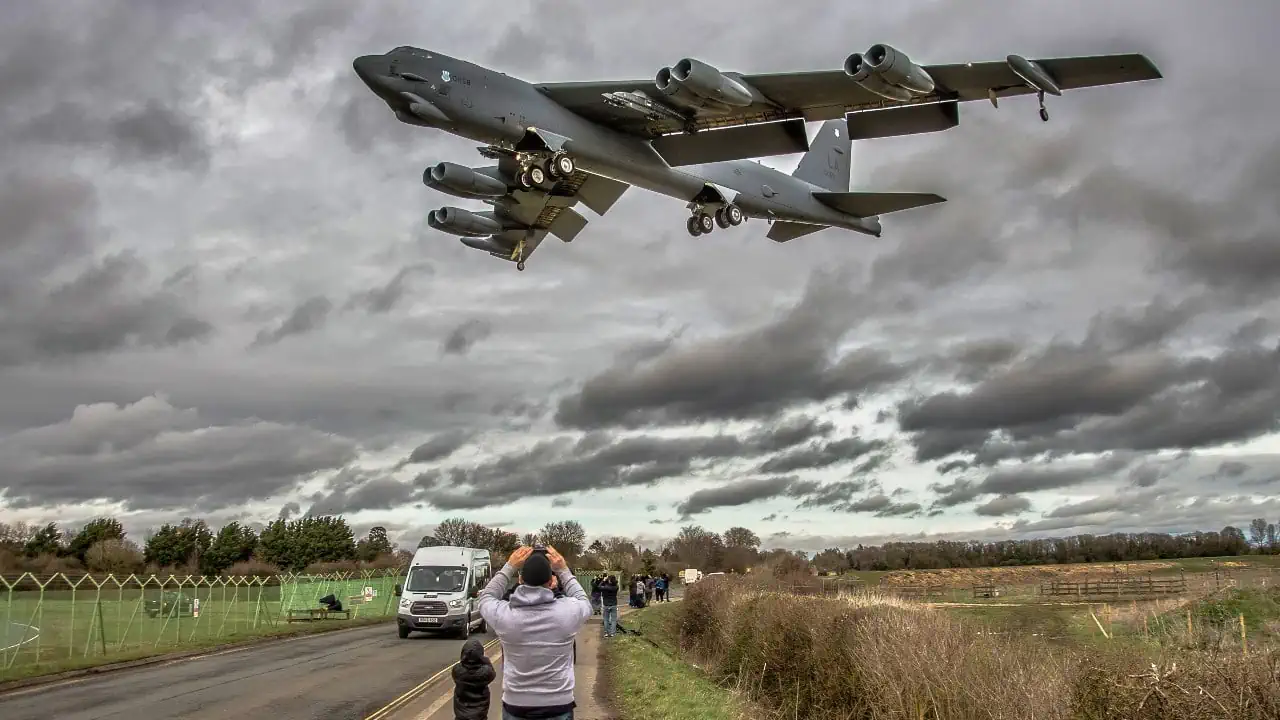
B-52 Stratofortress: The Bomber That Refused to Die
There are warplanes, and then there is the B-52 Stratofortress. Designed when propeller-driven aircraft still ruled the skies, this massive eight-engine bomber has outlasted every supersonic rival built to replace it, served in every major American conflict since the Cold War, and is currently undergoing a billion-dollar modernization program to keep it flying until at least 2050. No other combat aircraft in history comes close to matching that record.
Known affectionately — and bluntly — among its crews as the BUFF (Big Ugly Fat Fella), the Stratofortress is not graceful. It is not stealthy. But with a weapons payload exceeding 70,000 pounds and an unrefueled combat range of over 8,800 miles, it does not need to be. When a B-52 shows up, the mission is already decided.
Overview: What Is the B-52 Stratofortress?
The B-52 Stratofortress is a long-range, heavy strategic bomber designed, built, and continuously upgraded by Boeing for the United States Air Force (USAF). It has been in continuous operational service since 1955 — longer than any other combat aircraft in history.
Aircraft type: Heavy strategic bomber
Country of origin: United States
Manufacturer: Boeing
Primary roles: Nuclear and conventional strike, maritime surveillance, close air support (CAS), air interdiction, and standoff cruise missile delivery
First operational service: June 1955, with Strategic Air Command (SAC)
The B-52 was conceived at the height of Cold War tension, when the United States urgently needed a platform capable of delivering nuclear weapons across intercontinental distances without stopping. It replaced the piston-powered Convair B-36 Peacemaker, and it did so decisively — carrying heavier payloads, flying higher, and covering more ground than anything before it. Today, the B-52H forms one leg of America’s nuclear triad alongside submarine-launched ballistic missiles and land-based ICBMs.
History and Development: A Design Born Over a Weekend
The story of the B-52 begins in June 1946, when Boeing received a contract to design a new long-range jet bomber. Early designs featured straight wings and turboprop engines — practical, but uninspiring. The breakthrough came in October 1948, during a pivotal weekend in Dayton, Ohio.
A Boeing engineering team, led by Ed Wells, checked into a hotel and completely redesigned the aircraft over two days. They abandoned the turboprop concept, adopted swept wings at a 35-degree angle, and configured the aircraft for eight turbojet engines. They even built a hand-carved wooden scale model to present to Air Force officials — and it worked.
The prototype, designated YB-52, made its maiden flight on April 15, 1952, at Boeing Field in Seattle. Full production began shortly after, and the first operational B-52s were delivered to Strategic Air Command in June 1955. Boeing ultimately produced 744 aircraft across eight variants — from the B-52A through the definitive B-52H — before production ended in 1962.
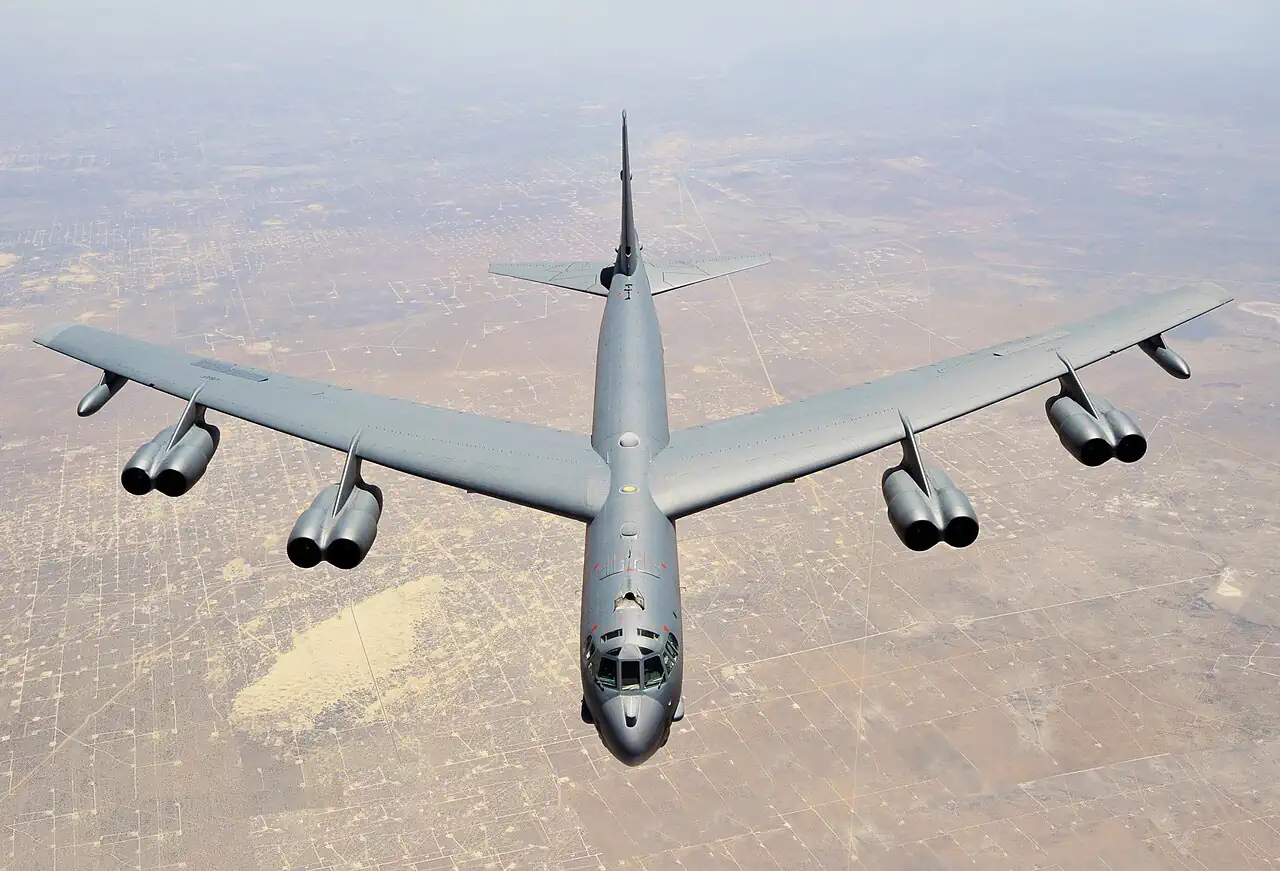
Design and Technology: Built to Last a Century
The B-52H’s airframe is a testament to the foresight of Boeing’s engineers. Constructed primarily from high-strength aluminum alloy, the aircraft stretches 159 feet 4 inches (48.5 m) in length, with a wingspan of 185 feet (56.4 m) — roughly the width of a football field.
One of the most striking features of the B-52 in flight is its wing flex. The swept wings are intentionally designed to bend significantly — up to eight feet at the tips under heavy load — distributing aerodynamic stress rather than absorbing it rigidly. This flexibility is a key reason the airframe has remained structurally sound for decades.
The avionics suite has been heavily modernized:
Radar: The legacy AN/APQ-166 is being replaced by the AN/APQ-188 AESA radar, derived from the F/A-18 Super Hornet — introduction planned for 2026
Cockpit: The CONECT upgrade replaced analog instruments with color multi-function displays and integrated digital mission management
Communications: Link 16 data link, AEHF SATCOM, and jam-resistant radios
Targeting pods: Litening and Sniper advanced targeting pods for electro-optical and infrared precision strike
Electronic warfare: Active jamming, chaff and flare dispensers, and radar warning receivers
Armament: 70,000 Pounds of Precision Destruction
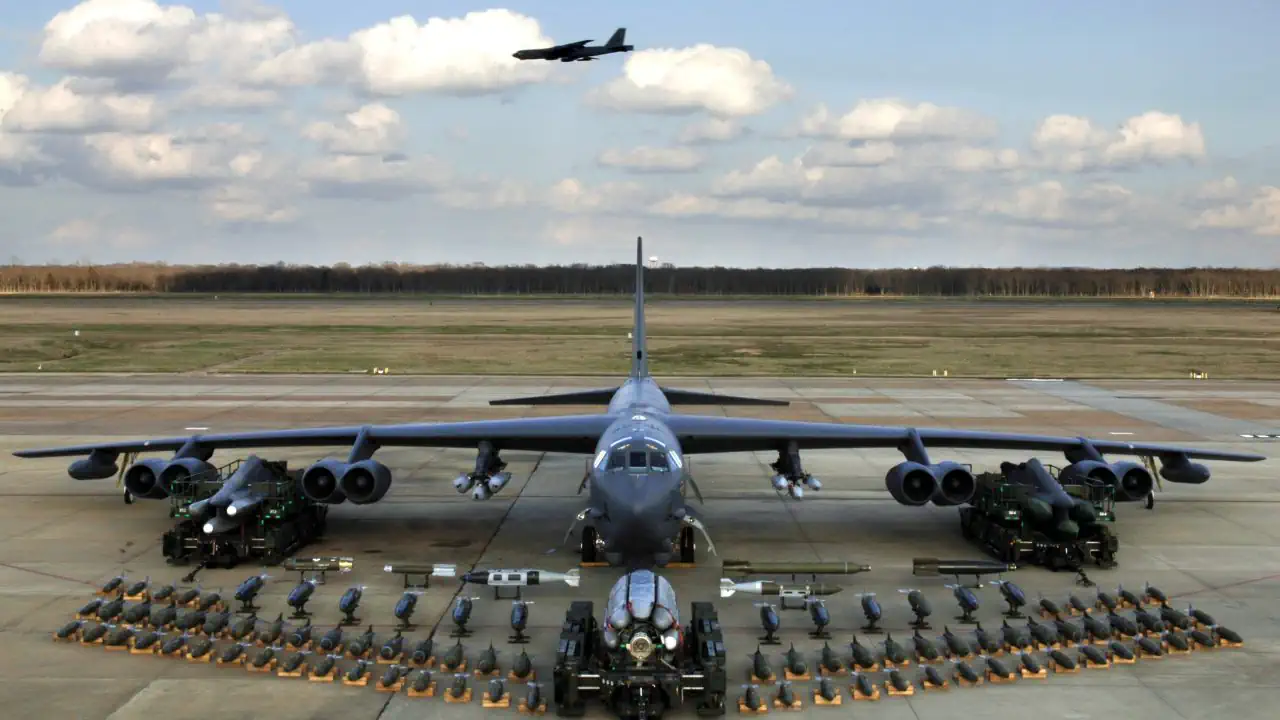
The Stratofortress is certified to carry approximately 70,000 pounds (31,500 kg) of mixed ordnance across its internal weapons bay and six underwing hardpoints:
AGM-86B ALCM: Nuclear-armed standoff cruise missile with range exceeding 1,500 miles
AGM-86C/D CALCM: Conventional variant used in Operation Desert Fox and beyond
AGM-158B JASSM-ER: Stealthy precision missile with range over 575 miles; the IWBU upgrade doubled internal capacity
GBU-28 Bunker Buster: 5,000-pound laser-guided bomb for hardened underground targets
JDAM: GPS-guided bomb kits for Mk 82, Mk 83, and Mk 84 free-fall bombs
Future — AGM-181 LRSO: Next-generation nuclear cruise missile to replace the AGM-86B
The original M61 Vulcan 20mm tail cannon was removed from all aircraft in 1991
Performance: Long, Slow, and Devastating
| Performance Metric | B-52H Stratofortress |
|---|---|
| Maximum speed | 650 mph (1,050 km/h / Mach 0.86) |
| Cruise speed | 509 mph (819 km/h) |
| Unrefueled combat range | 8,800 miles (14,200 km) |
| Service ceiling | 50,000 ft (15,240 m) |
| Rate of climb | 6,270 ft/min (31.9 m/s) |
| Max payload | 70,000 lb (31,500 kg) |
| Max takeoff weight | 488,000 lb (221,360 kg) |
| Lift-to-drag ratio | ~21.5 (estimated) |
Technical Specifications
| Specification | B-52H Stratofortress |
|---|
| Specification | B-52H Stratofortress |
|---|---|
| Country | United States |
| Manufacturer | Boeing |
| Year introduced (H-model) | 1961 |
| Crew | 5 (pilot, copilot, radar navigator, navigator, electronic warfare officer) |
| Empty weight | 185,000 lb (83,250 kg) |
| Max takeoff weight | 488,000 lb (221,360 kg) |
| Length | 159 ft 4 in (48.5 m) |
| Wingspan | 185 ft 0 in (56.4 m) |
| Height | 40 ft 8 in (12.4 m) |
| Maximum speed | 650 mph (Mach 0.86) |
| Combat range | 8,800 miles (14,200 km) |
| Service ceiling | 50,000 ft (15,240 m) |
| Engines | 8× Pratt & Whitney TF33-P-3/103 (upgrading to Rolls-Royce F130) |
| Thrust (each engine) | 17,000 lbf (76 kN) |
| Primary armament | AGM-86 ALCM, AGM-158B JASSM-ER, LRSO (future) |
| Secondary armament | JDAM, Mk 82/84 bombs, sea mines, GBU-28 |
| Operational status | Active — 76 aircraft; B-52J modernization underway |
Combat History: Seven Decades of War
Cold War Deterrence (1955–1991)
For over a decade, B-52s maintained continuous airborne alert patrols under programs codenamed Chrome Dome, Head Start, and Giant Lance — many armed with nuclear weapons and flying orbits near Soviet borders, ready to execute strike missions within minutes.
Vietnam War (1965–1973)
B-52D and F models flew thousands of Arc Light carpet-bombing missions from Guam, Okinawa, and Thailand. The campaign’s defining moment: Operation Linebacker II in December 1972 — over 200 B-52s flying 729 sorties in 11 days against Hanoi and Haiphong, directly leading to the Paris Peace Accords.
Gulf War (1991)
B-52Gs flew from Diego Garcia and from Barksdale AFB, Louisiana — completing one of the longest combat missions in aviation history at over 35 hours round trip — striking Iraqi Republican Guard positions and strategic infrastructure.
Bosnia (1995) and Kosovo (1999)
B-52s delivered cruise missiles against Serbian targets as part of NATO campaigns, demonstrating precision standoff strike capability without entering defended airspace.
Afghanistan (2001–2021)
Operating from Diego Garcia and regional forward bases, B-52s provided close air support, interdicted Taliban supply lines, and struck hardened cave complexes. Long loiter time and massive payload made the aircraft invaluable in this role.
Anti-ISIS Campaign (2014–present)
B-52Hs have conducted sustained precision strikes against Islamic State targets across Iraq and Syria using JDAM-guided munitions.
Strengths of the B-52 Stratofortress
Unmatched range: Over 8,800 miles without refueling — any target on Earth is reachable from U.S. soil with tanker support
Massive payload flexibility: Nuclear cruise missiles, conventional bombs, precision-guided munitions, and sea mines — all on the same airframe
Low operating cost: Significantly cheaper per flight hour than the B-2 Spirit
Continuous modernization potential: Multiple generations of avionics, weapons, and engine upgrades without structural replacement
Standoff strike capability: JASSM-ER and ALCM allow strikes on heavily defended targets without entering threat envelopes
Combat-proven reliability: 70+ years of operational data with well-understood maintenance profiles
Nuclear triad certification: Carries both gravity nuclear bombs and nuclear-armed cruise missiles
Limitations of the B-52 Stratofortress
No stealth capability: Large radar cross-section makes it highly detectable by modern integrated air defense systems
Subsonic speed only: Cannot evade modern air-to-air missiles or supersonic interceptors
Aging systems: Despite upgrades, some legacy components require intensive maintenance
Large crew requirement: Five crew members per aircraft increases training requirements and risk exposure
Escort dependency: Requires fighter escort and SEAD support in high-threat environments
Runway requirements: High takeoff weight demands long, well-maintained runways, limiting forward basing options
B-52 vs. B-1B vs. B-2: America’s Bomber Fleet Compared
| Feature | B-52H | B-1B Lancer | B-2 Spirit |
|---|---|---|---|
| Top speed | Mach 0.86 | Mach 1.25 | Mach 0.95 |
| Combat range | 8,800 mi | 7,456 mi | 6,900 mi |
| Max payload | 70,000 lb | 75,000 lb | 50,000 lb |
| Stealth | ❌ None | ❌ Limited | ✅ Full |
| Unit cost | ~$84M | ~$283M | ~$2.1B |
| Fleet size | 76 active | Being retired | 20 active |
| Nuclear certified | ✅ Yes | ❌ No | ✅ Yes |
| Key strength | Range + cost | Speed + payload | Stealth penetration |
Variants and the B-52J Modernization Program
Production Variants (1952–1962):
B-52A: Three aircraft built exclusively for flight testing; never entered operational service
B-52B: First combat-ready variant; nuclear delivery certified with Strategic Air Command
B-52C through F: Progressive improvements in fuel capacity, bombing systems, and electronic warfare; D and F models were the Vietnam workhorses
B-52G: Shorter vertical tail, integral wing fuel tanks, remote-controlled tail gun; largest production run of any variant
B-52H: Definitive and only surviving operational variant; introduced Pratt & Whitney TF33 turbofans, dramatically improving efficiency and range
Current Modernization — The Road to B-52J:
CERP (Commercial Engine Replacement Program): Boeing received a $2.04 billion contract in December 2025 to re-engine the fleet with Rolls-Royce F130-200 turbofans — 40% more fuel-efficient; re-engined aircraft redesignated B-52J, completion by 2033
Radar Modernization Program: AN/APQ-166 replaced by AN/APQ-188 AESA radar, installation beginning 2026
CONECT: Digital cockpit displays, Link 16, and integrated mission management — already fleet-wide
IWBU: Internal rotary launcher converted to carry AGM-158B JASSM-ER, nearly doubling internal precision weapons capacity
LRSO Integration: B-52J to serve as primary platform for the AGM-181 nuclear cruise missile
AEHF SATCOM: Hardened satellite communications for contested electromagnetic environments
11 Fascinating Facts About the B-52 Stratofortress
The B-52 has been flown by three generations of the same families — grandfathers, fathers, and sons have all logged hours in the BUFF
Boeing engineers designed the definitive B-52 layout in a single weekend at a Dayton, Ohio hotel in October 1948 — and hand-carved a wooden model to present to Air Force leadership
In January 1966, a B-52 collided with a KC-135 tanker over Palomares, Spain, scattering four hydrogen bombs across the countryside. None detonated; one was recovered from the Mediterranean after an 80-day search
The longest combat mission in B-52 history lasted over 35 hours — a Gulf War sortie flown from Barksdale AFB, Louisiana, to Iraq and back in January 1991
During Operation Linebacker II, B-52s flew 729 combat sorties in just 11 days
The B-52’s wings flex up to eight feet at the tips during cruise flight — a design feature, not a structural flaw
The aircraft carries 47,975 U.S. gallons (181,610 liters) of fuel — enough to fill roughly 1,200 standard car gas tanks
With the Rolls-Royce F130 engines, the B-52J will be approximately 40% more fuel-efficient than current aircraft
The B-52 has participated in over 126,000 combat sorties across its operational lifetime
The BUFF nickname is said to have originated with ground crews who maintained a blunt affection for the aircraft’s massive, ungainly silhouette
If the B-52 remains in service until 2060, it will have served for over 105 years — an unmatched record in all of military aviation history
Strategic Impact: How the B-52 Changed Modern Warfare
The B-52 Stratofortress did not merely participate in the Cold War — it helped define it. By providing the United States with a credible, continuously airborne nuclear strike capability, the Stratofortress made large-scale conflict between superpowers calculably irrational. The concept of Mutually Assured Destruction only worked because the BUFF made retaliation inevitable.
Beyond nuclear deterrence, the B-52 pioneered the modern concept of standoff strike warfare. By integrating long-range cruise missiles in the 1980s, it proved that a bomber did not need to overfly a target — or even enter defended airspace — to destroy it. That principle now underpins the strike doctrine of every major air force in the world.
The aircraft’s sustained service life also proved a principle that shapes procurement decisions across the defense industry today: a well-designed airframe with upgrade headroom is worth more than periodic replacement. The B-52’s low per-hour operating cost ensures it will remain the backbone of the USAF’s conventional standoff strike capability even as stealth bombers handle high-threat penetration missions.
Frequently Asked Questions (FAQ)
1. When did the B-52 Stratofortress enter service?
The B-52 entered operational service with Strategic Air Command in June 1955, making it the longest-serving combat aircraft in U.S. military history.
2. How many B-52s are currently operational?
The U.S. Air Force maintains approximately 76 B-52H aircraft across active-duty bomb wings at Barksdale AFB (2nd BW) and Minot AFB (5th BW), reserve forces, and long-term storage at Davis-Monthan AFB.
3. Can the B-52 carry nuclear weapons?
Yes. The B-52H is a certified nuclear delivery platform and serves as the airborne leg of America’s nuclear triad, currently carrying the AGM-86B ALCM and slated to carry the future AGM-181 LRSO.
4. What does BUFF stand for?
BUFF stands for Big Ugly Fat Fella — the official, printable version of a nickname that has been used by B-52 crews for decades.
5. What is the B-52J?
The B-52J is the redesignation for B-52H aircraft re-engined with Rolls-Royce F130-200 turbofans under the Commercial Engine Replacement Program (CERP). Fleet-wide conversion is expected by 2033.
6. How far can a B-52 fly without refueling?
The B-52H has a combat range of approximately 8,800 miles (14,200 km) without aerial refueling. With tanker support, range is effectively unlimited.
7. Has the B-52 ever used nuclear weapons in combat?
No. The B-52 has never deployed nuclear weapons in combat. All combat missions have involved conventional munitions exclusively.
8. Why is the B-52 being kept while the B-1B is retired?
The B-52 offers longer range, nuclear certification, lower operating costs, and a more upgradeable airframe than the B-1B Lancer — making it the more cost-effective long-term platform alongside the incoming B-21 Raider.
9. What is the B-52’s maximum speed?
The B-52H has a maximum speed of 650 mph (1,050 km/h, approximately Mach 0.86) at altitude.
10. How long will the B-52 remain in service?
Current USAF planning calls for the B-52 to remain operational until at least 2050. Some analysts project continued service beyond that date, potentially making it the first military aircraft to serve for over a century.
America’s Eternal Bomber: Still the Standard After 70 Years
The Boeing B-52 Stratofortress is the most consequential bomber in the history of air power. It shaped the Cold War, helped end the Vietnam conflict, defined the Gulf War’s air campaign, and continues to project American military power from bases on every continent. With a $2 billion re-engining program underway, new AESA radar systems being installed, and the next generation of nuclear cruise missiles on the horizon, the BUFF is not a relic — it is an actively evolving weapons system with decades of lethal relevance ahead.
No other aircraft in history has combined longevity, adaptability, and strategic impact at this scale. The B-52 will still be flying long after many of its supposed replacements have been retired.
If you found this article valuable, explore our in-depth coverage of the B-21 Raider — America’s next-generation stealth bomber — the B-2 Spirit’s legacy and retirement timeline, and the full evolution of U.S. nuclear deterrence strategy from the Cold War to the present day.

Joseli Lourenço
06/22/2026