Arena-M Active Protection: How the T-90M Defends Itself
Russia’s T-90M Proryv pairs Relikt reactive armor and Arena-M active protection with a 125mm gun — yet combat losses expose serious design flaws.
T-90M Proryv: Russia’s Most Advanced Tank Has a Fatal Weak Spot
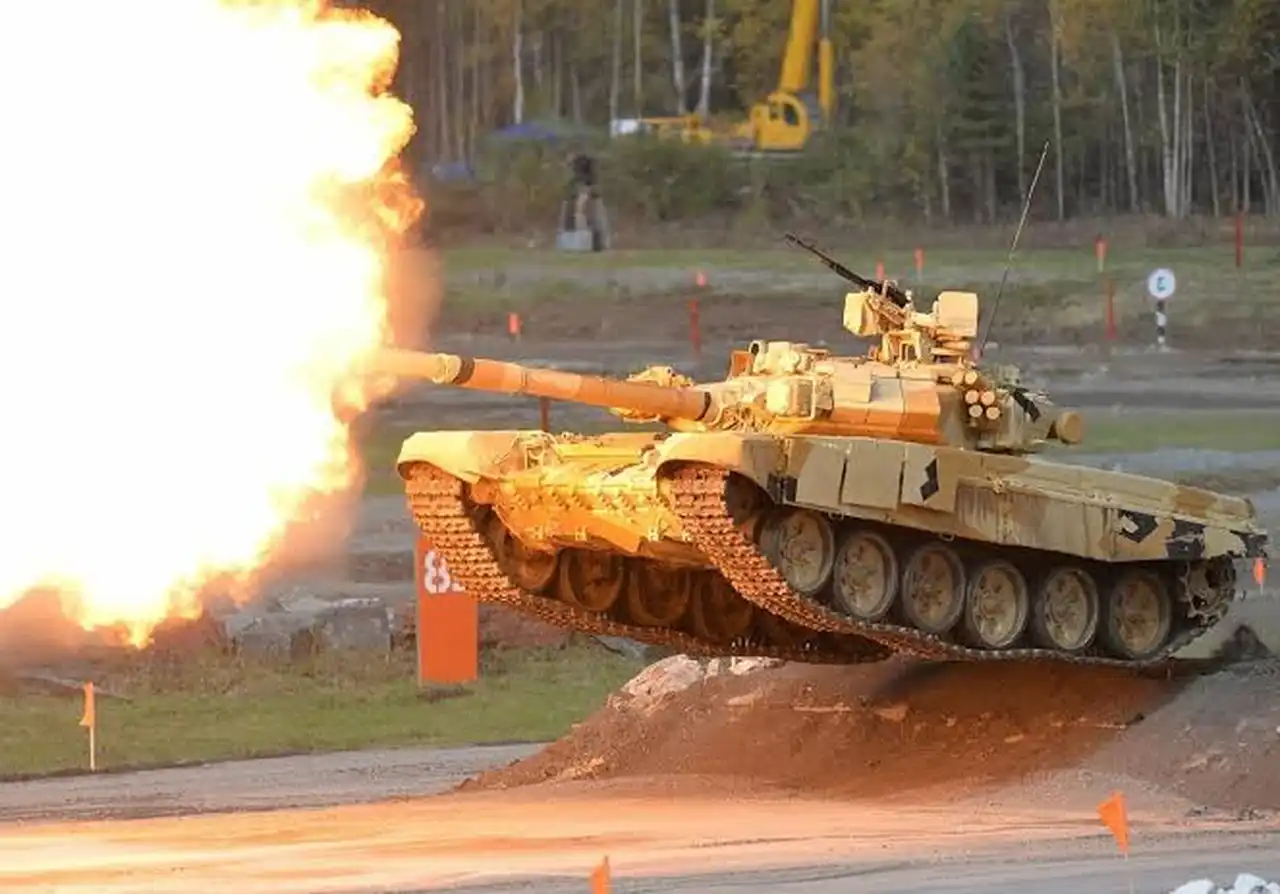
Russia’s frontline main battle tank, the T-90M Proryv, was built to fix everything wrong with its predecessors — outdated armor, weak electronics, and a fire-control system stuck in the past. Manufactured by Uralvagonzavod, a subsidiary of the state defense conglomerate Rostec, the T-90M traces its lineage back through the original T-90 to the Soviet-era T-72BU. Its name, “Proryv,” translates roughly to “breakthrough.”
First shown publicly in 2017, the tank didn’t reach frontline units until 2020-2021, when Uralvagonzavod began delivering production models to the Russian Army. The goal behind the “Proryv-3” program was straightforward: bring Russia’s aging T-90A fleet up to a genuinely modern standard, addressing armor gaps and electronics that had fallen behind Western equivalents.
What Sets the T-90M Apart
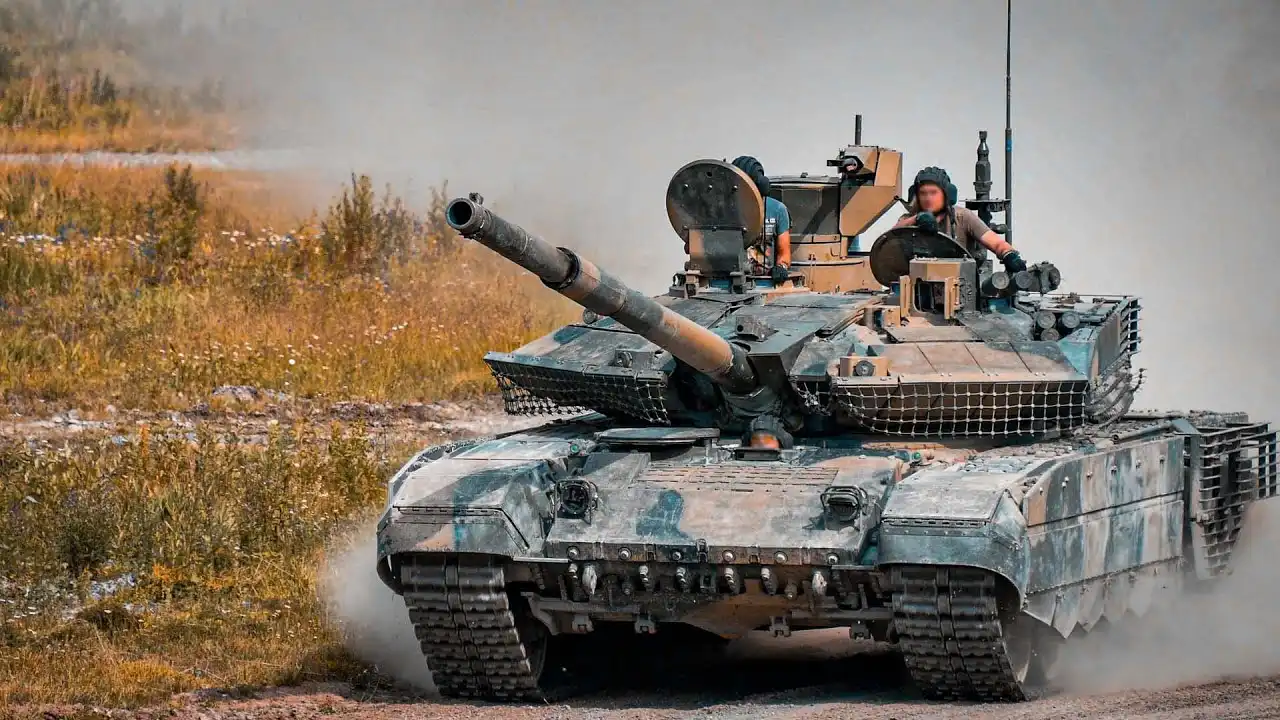
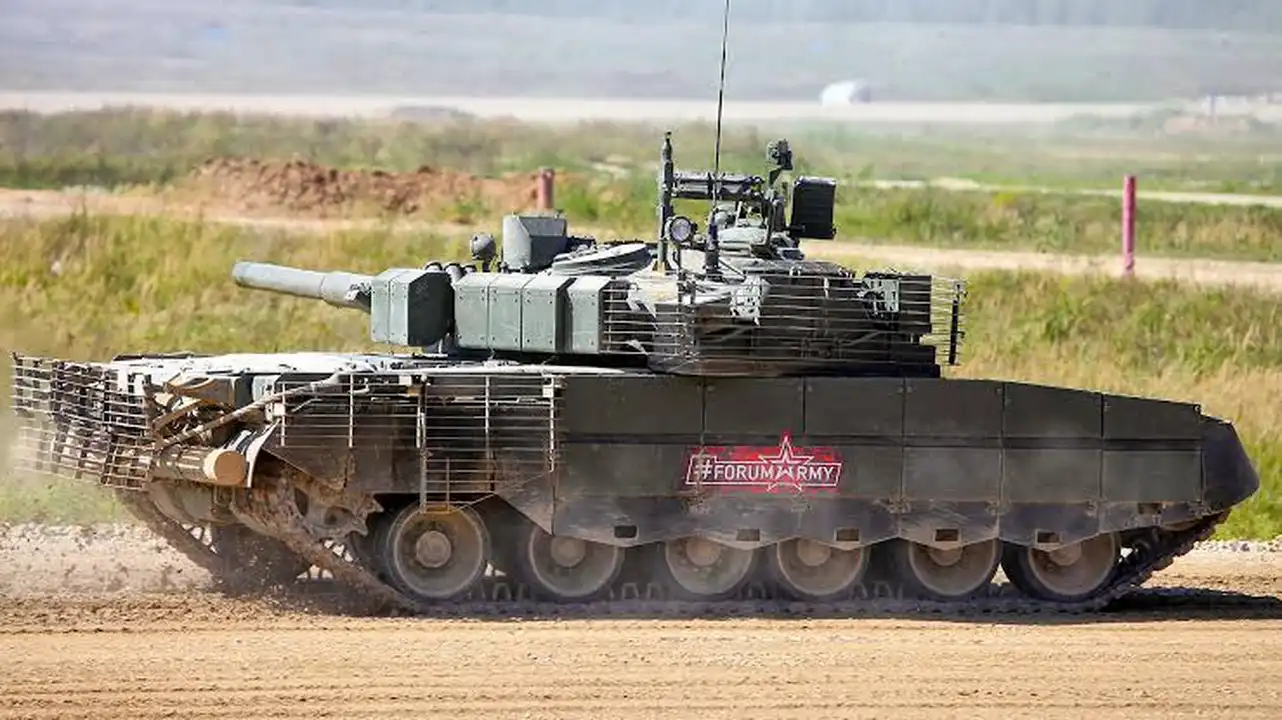
Earlier T-90 variants used a cast turret. The T-90M switched to a fully welded turret, a design choice that improves weight distribution and makes it easier to bolt on extra protection layers. That protection centers on composite armor paired with Relikt, a third-generation explosive reactive armor (ERA) system built to defeat both standard HEAT warheads and tandem-charge munitions designed to bypass reactive armor.
Target acquisition runs through the Sosna-U sight for the gunner and the PK PAN panoramic sight for the commander, giving the crew genuine hunter-killer capability — the commander can spot a new target while the gunner is still engaging the current one. The thermal imaging system reportedly detects targets out to roughly 3,300 meters (about 2 miles). All of this feeds into the Kalina digital fire-control system, which handles targeting calculations and ballistic corrections.
For self-defense, the tank carries the Shtora-1 countermeasure suite, a soft-kill system that jams laser rangefinders and guided missiles. More significantly, production batches from 2024 onward began incorporating Arena-M, a hard-kill active protection system. It uses a 360-degree Doppler radar to detect incoming threats and fire countermunitions in roughly 0.07 seconds — fast enough, following recent software updates, to intercept small FPV drones as well.
Firepower: A 125mm Gun With Missile Capability
The T-90M’s primary weapon is the 2A46M-5 smoothbore cannon, 125mm in caliber, fed by an autoloader carrying 43 rounds. One notable feature is the tank’s ability to fire the 9M119 Refleks guided anti-tank missile directly through the gun barrel, extending its effective engagement range to roughly 5,000 meters — well beyond what conventional kinetic rounds can reliably hit.
Secondary armament includes a coaxial 7.62mm PKMT machine gun and a remotely operated 12.7mm heavy machine gun (either the NSVT or Kord), which the crew can fire without exposing themselves outside the vehicle.
T-90M Technical Specifications
| Specification | Value |
|---|---|
| Combat weight | 48-51 tonnes |
| Crew | 3 (commander, gunner, driver) |
| Engine | V-92S2F diesel, 1,130 hp |
| Top speed | 60-70 km/h (37-43 mph) on road |
| Operational range | 500-550 km (310-341 miles) |
| Main gun | 125mm 2A46M-5 |
With a power-to-weight ratio around 22-23.5 hp per tonne, the T-90M handles soft or muddy terrain reasonably well. But it inherits a longstanding Soviet-design limitation: reverse gear is slow, which limits “shoot-and-scoot” tactics common to more maneuverable Western tanks.
Combat Performance in Ukraine
The real test came after 2022. Despite pre-war marketing that presented the T-90M as Russia’s technological showcase tank, it has taken heavy losses in Ukraine, particularly around the Kharkiv front. According to the open-source tracking project Oryx, confirmed T-90M losses had surpassed 155 units by mid-2026.
The tank’s most exploited weakness sits at the turret roof and engine compartment, both thinly armored against FPV kamikaze drones, loitering munitions, and top-attack missiles like the Javelin. Compounding this, the autoloader’s carousel ammunition storage — a design inherited from the T-72 — remains prone to catastrophic detonation if the hull is penetrated. When that happens, the explosion often blows the entire turret clean off the chassis, a failure mode observers have nicknamed the “jack-in-the-box” effect.
In response, Russian forces have rushed improvised anti-drone cages (“cope cages”) onto fielded vehicles, and newer production batches now pair Arena-M with software specifically tuned to detect and intercept FPV drone attacks.
T-90M vs M1 Abrams: How It Stacks Up Against the West
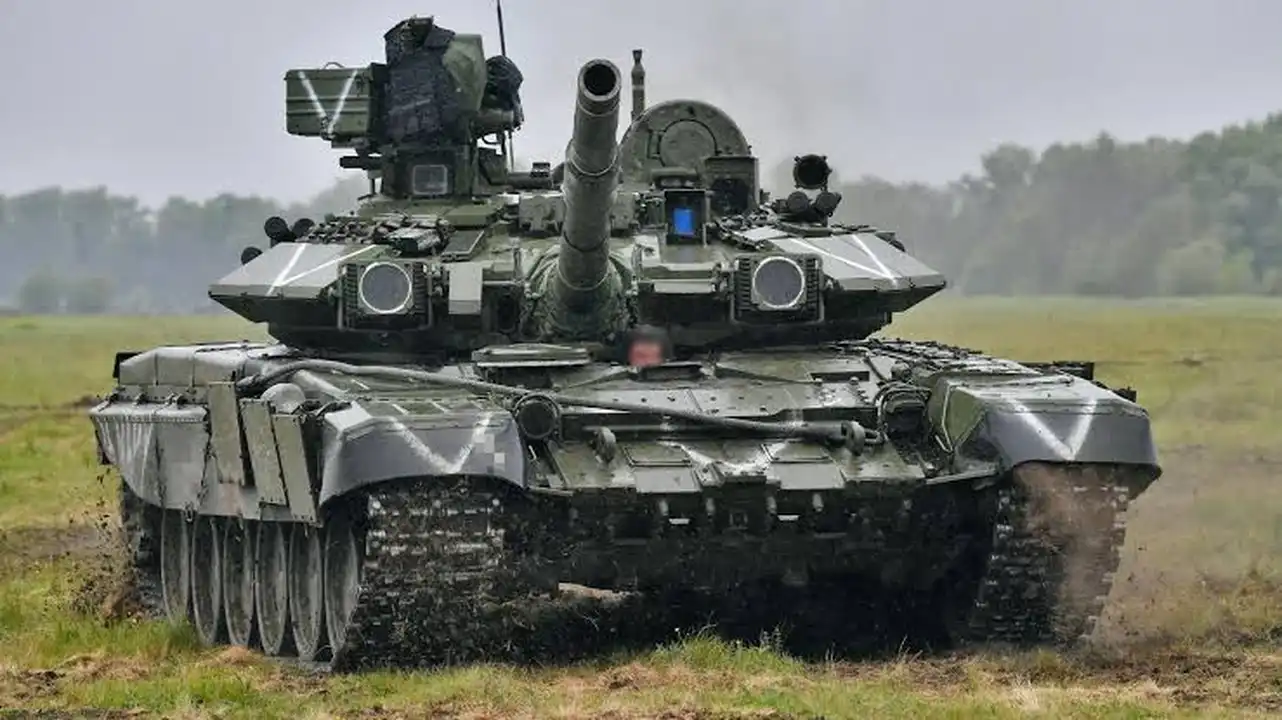
The T-90M’s most frequently cited Western counterpart is the American M1 Abrams (Germany’s Leopard 2 draws similar comparisons). The two designs diverge sharply in philosophy:
| Feature | T-90M | M1 Abrams |
|---|---|---|
| Weight | 48-51 t | 65-70+ t |
| Height | 2.23 m | ~2.5-3 m |
The T-90M’s lighter weight and lower profile give it a real mobility edge — it’s harder to spot and can cross bridges that would collapse under an Abrams. The Abrams counters with isolated ammunition storage behind blow-off panels, a design that vents an internal explosion upward and away from the crew compartment — a survivability feature the T-90M’s carousel-loading system doesn’t match.
Strengths and Weaknesses
Strengths: Effective frontal protection from Relikt ERA, a low silhouette that reduces detectability, long-range guided missile capability through the main gun, a significantly lower unit cost than NATO equivalents (roughly $4.5 million), and strong mobility across soft terrain.
Weaknesses: Dangerously exposed ammunition storage, high vulnerability to FPV drones and top-attack munitions, sluggish reverse speed, and optical sensor systems reportedly hampered by sanctions affecting component supply chains.
Notable Facts
Perhaps the most striking statistic to emerge from the war: FPV drones costing roughly $300 have repeatedly been documented destroying a tank valued at $4.5 million — a cost asymmetry that has become a defining feature of modern armored warfare. On the engineering side, fitting the Arena-M system forced Uralvagonzavod to relocate the smoke grenade launchers, previously built into the turret’s low profile, to more exposed mounting points.
Frequently Asked Questions
Is the T-90M Russia’s most advanced tank?
Yes, it’s currently the primary main battle tank in active service with the Russian Army.
What’s different between the T-90M and the T-90A?
The T-90M has a welded turret, Relikt reactive armor, the Kalina fire-control system, and significantly upgraded electronics over the T-90A.
Does the T-90M have missile defense?
Recent production batches include Arena-M, a hard-kill system that intercepts incoming projectiles roughly 50 meters from the vehicle.
How many T-90M tanks have been lost in the war?
Oryx had confirmed more than 155 losses as of mid-2026, based on visually documented evidence.
Can the T-90M fire missiles from its main gun?
Yes, it launches the 9M119 Refleks guided missile through the barrel, with an effective range of up to 5 km.
Bottom Line
The T-90M combines advanced reactive armor, modern fire control, and long-range guided missile capability, giving it a genuine mobility advantage over heavier Western tanks. But its exposed ammunition storage and thin top armor have made it a recurring target for low-cost drones, exposing a sharp gap between the tank’s price tag, its technology, and its real-world survivability.

Joseli Lourenço
08/04/2026