T-14 Armata: Russia’s Unmanned-Turret Main Battle Tank Explained
Russia’s T-14 Armata isolates its crew in an armored capsule while the turret runs unmanned. Here’s how its armor, firepower and combat record actually stack up.
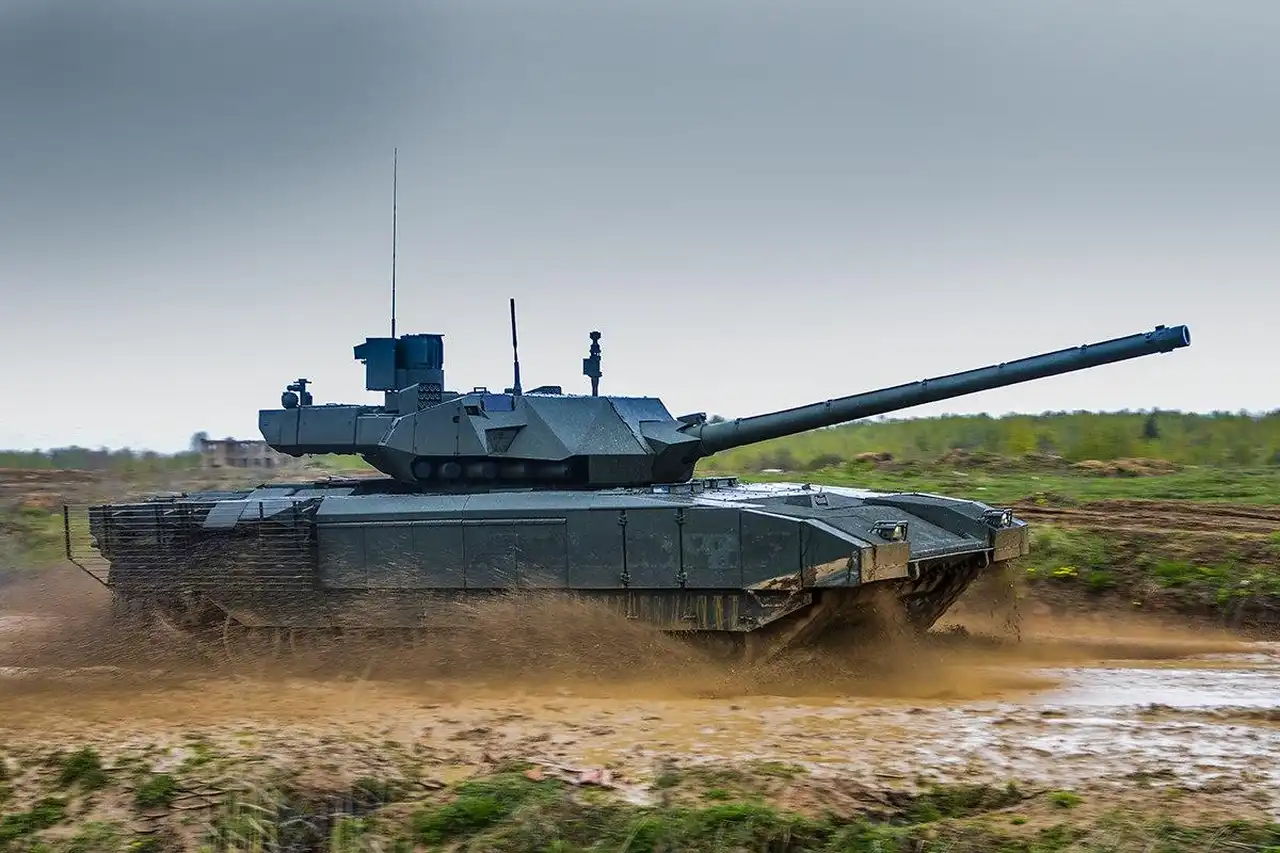
T-14 Armata: Inside Russia’s Unmanned-Turret Main Battle Tank
What Is the T-14 Armata
The T-14 Armata is a Russian main battle tank (MBT) built by Uralvagonzavod under the internal designation Object 148. It drew global attention for one distinctive feature: the turret operates without a crew inside it. All three crew members — commander, gunner and driver — sit together in an armored capsule at the front of the hull, physically separated from the turret and its ammunition.
Origins and Development Background
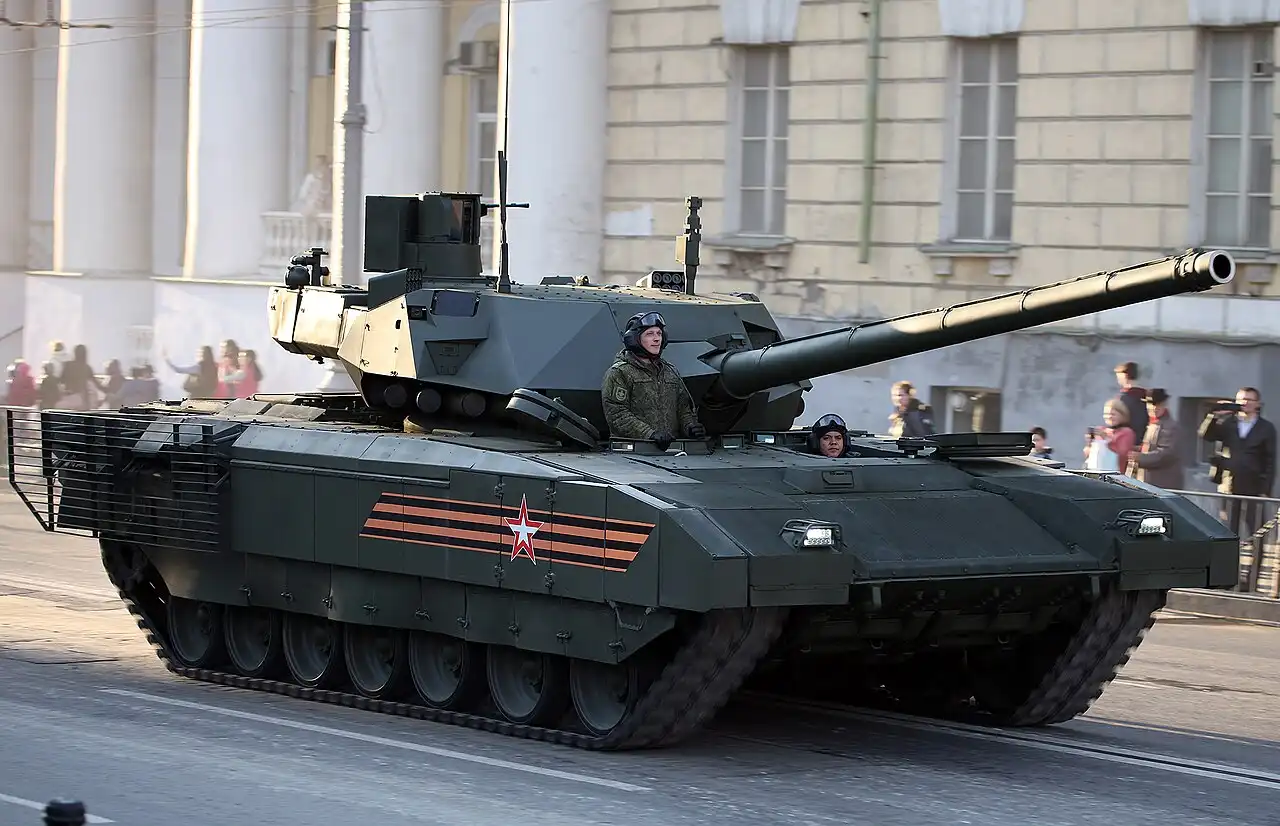
Design work started in 2013 at Uralvagonzavod, one of Russia’s largest armored vehicle manufacturers. The tank made its public debut in May 2015 at Moscow’s Victory Day parade, immediately drawing attention from defense analysts worldwide for its unconventional layout compared to earlier Soviet and Russian designs.
From Prototype to Limited Service
Russia’s original goal was ambitious: field roughly 2,300 Armata-platform vehicles by 2020 to equip elite units such as the 1st Guards Tank Army. That target was never reached. Reports from 2022 onward pointed to a program that had effectively stalled, driven by the invasion of Ukraine, defense budget pressure, and supply chain disruptions tied to sanctions.
Design, Sensors and Protection Systems
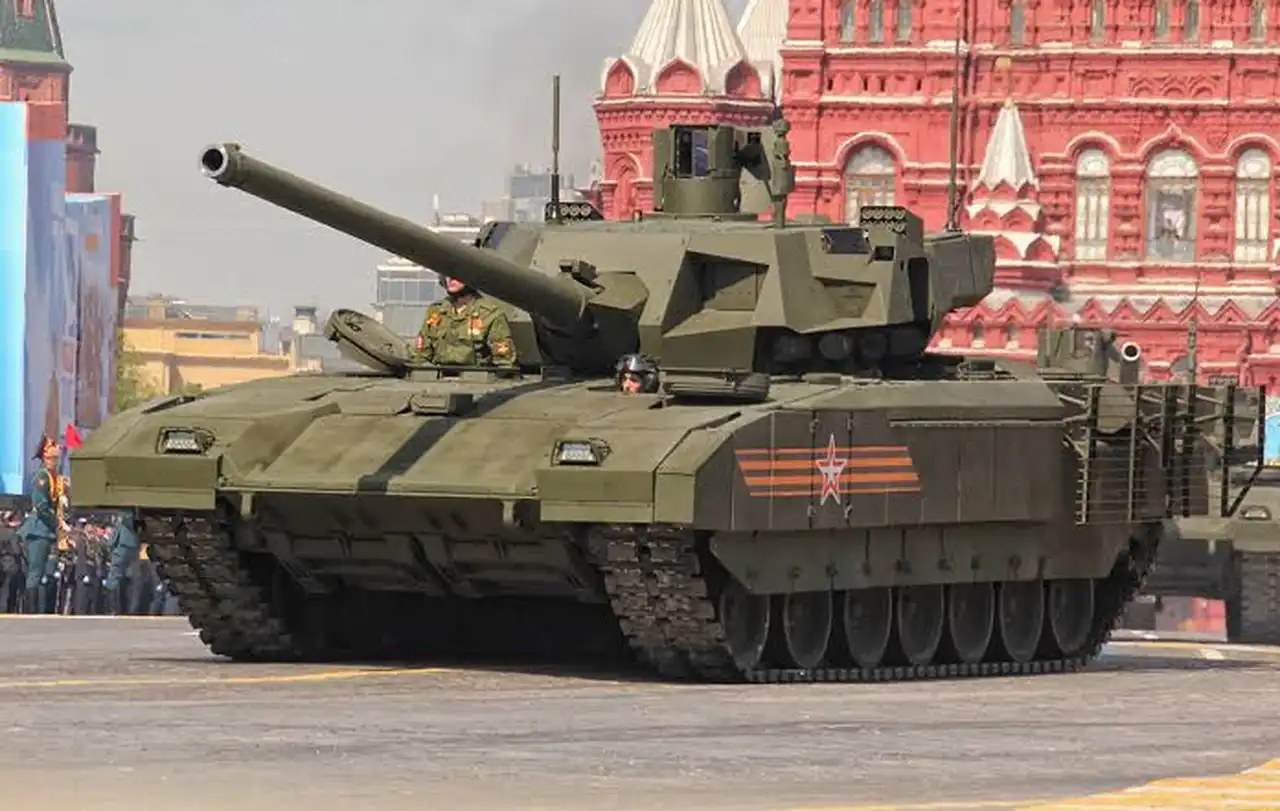
The T-14 breaks from decades of Soviet tank design by removing the crew from the turret entirely. Instead, all onboard personnel operate from a sealed armored capsule in the hull — an approach intended to sharply improve survivability if the turret takes a direct hit.
Protection comes from a mix of 44S-sv-Sh steel, composite armor modules, and Malakhit explosive reactive armor (ERA). Active defense is handled by the Afghanit active protection system, designed to detect and intercept incoming projectiles before impact. The tank also carries a digital fire-control system, laser rangefinder, thermal imaging cameras for night operations, a fire-control radar, and NBC (nuclear, biological, chemical) protection for the crew capsule.
Firepower and Offensive Capability
The main armament is the 2A82-1M smoothbore cannon, 125mm in caliber, capable of firing conventional rounds as well as guided anti-tank missiles such as the 9M119 Refleks. The autoloader carries 45 rounds in total, with 32 ready for immediate firing. Effective range runs from roughly 5 km to 12 km depending on ammunition type.
Secondary armament includes a remotely operated 12.7mm Kord heavy machine gun, with an optional 7.62mm coaxial machine gun available for close-range engagements.
Technical Specifications
| Specification | Value |
|---|---|
| Weight | 48–55 tons |
| Length | 10.7–10.8 m |
| Top speed | 80–90 km/h (50–56 mph) |
| Range | 500 km (310 miles) |
| Crew | 3 |
| Engine | ChTZ 12N360 twin-turbo diesel |
| Power output | 1,500 hp (limited to 1,200 hp) |
Notably, the engine is electronically capped at 1,200 hp even though it’s rated for 1,500 hp — a deliberate trade-off engineers made to extend service life, reportedly stretching the powerplant’s lifespan from around 2,000 hours to as much as 10,000 hours.
Operational Performance
With a favorable power-to-weight ratio and a 12-speed automatic transmission, the T-14 is generally considered agile for a vehicle in its weight class. Its hydropneumatic suspension, combined with torsion bars, supports mobility across rough terrain. Russia has not officially disclosed data on amphibious capability or maximum gun elevation.
Combat History
The T-14’s real-world combat exposure has been limited. Russia’s Ministry of Industry and Trade confirmed the tank underwent operational testing in Syria in early 2020. In Ukraine, it made its first documented appearance in April 2023, but was withdrawn from the front by August of that year — a short deployment window that suggests Russian commanders were reluctant to risk the platform, whether for operational or reputational reasons.
Strengths and Weaknesses
Strengths:
- Crew isolated from turret ammunition, improving survivability
- Afghanit active protection system
- Ability to fire guided missiles through the main gun
- Comparatively light weight, aiding mobility and logistics
- Above-average top speed for an MBT
Weaknesses:
- High unit cost (estimated between $5 million and $9.42 million)
- Never achieved true mass production
- High technical complexity complicates field maintenance
- Small fleet size limits strategic relevance
- Early withdrawal from active combat zones
How It Compares to Western Rivals
The T-14’s closest Western counterparts are the American M1A2 Abrams and the German Leopard 2. The key philosophical difference lies in crew protection: Western designs keep the crew inside a manned turret, while the Armata isolates them entirely in the hull.
| Tank | Weight |
|---|---|
| T-14 Armata | 48–55 t |
| M1A2 Abrams | ~66 t |
| Leopard 2 | ~62 t |
Despite its forward-looking design, the T-14 lags behind in combat-proven reliability. Western MBTs have decades of documented battlefield use, while the Armata still lacks large-scale operational history.
Variants and Future Upgrades
Beyond the standard 125mm-armed version, Russia has floated a theoretical variant fitted with a larger 152mm 2A83 cannon. There is no confirmed public information on the current development status of this upgrade.
Lesser-Known Facts
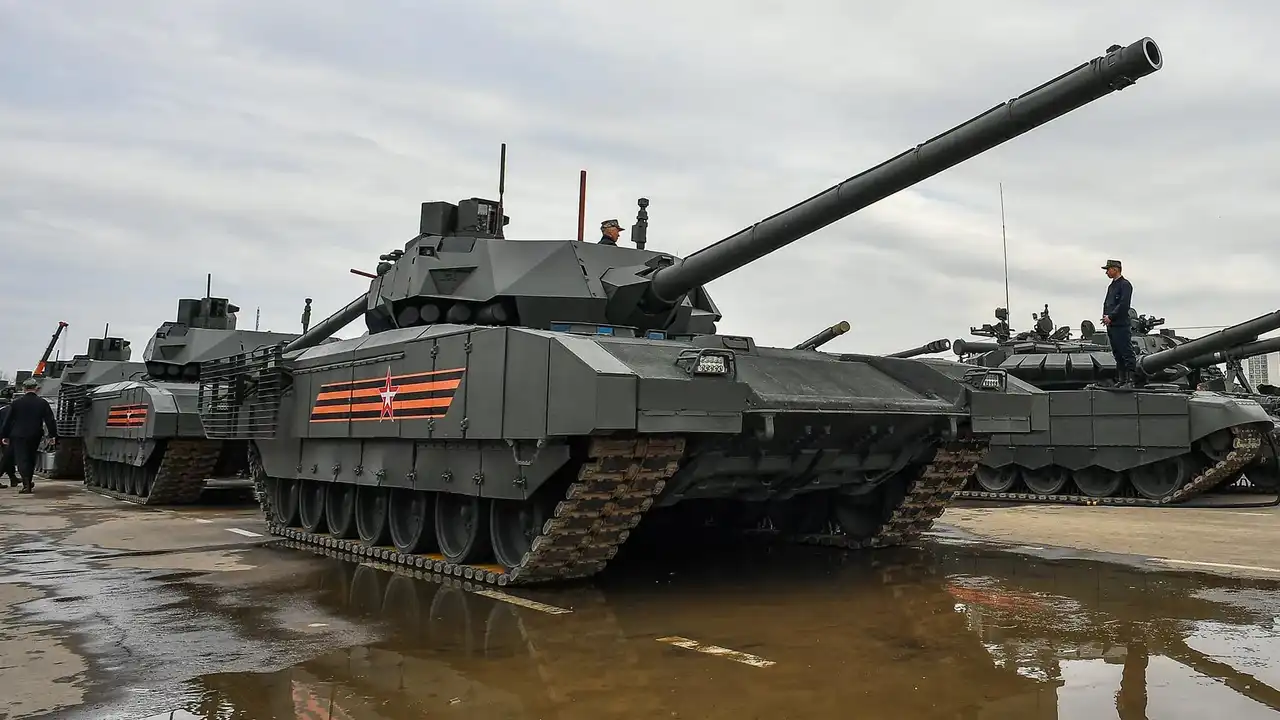
- The T-14 uses seven road wheels per track, departing from the six-wheel layout standard on earlier Soviet-era tanks.
- Because the turret is unmanned, the tank doesn’t need internal gun-gas extraction systems for crew safety, since no personnel are present in that compartment after firing.
Military and Technological Significance
Even without reaching mass production, the T-14 Armata has shaped broader discussion about the future of tank design, popularizing the unmanned-turret concept among defense analysts. Its most lasting impact so far may be conceptual — demonstrating a possible direction for armored vehicle design rather than proving itself as a widely fielded combat platform.
Frequently Asked Questions
Has the T-14 Armata seen actual combat?
Yes. It underwent testing in Syria in 2020 and had a brief deployment in Ukraine in 2023.
How many T-14 Armata tanks have been built?
Estimates vary, ranging from fewer than two dozen to around 40 delivered units.
How much does a T-14 Armata cost?
Current estimates place the unit cost between $5 million and $9.42 million.
Why didn’t Russia mass-produce the T-14?
High production costs, sanctions, budget cuts, and supply chain problems following 2022 all contributed to the stalled program.
Is the T-14 Armata better than the Abrams or Leopard 2?
It introduces innovative crew-protection concepts, but it lacks the combat history and production maturity of its Western rivals.
Bottom Line
The T-14 Armata remains one of the most ambitious tank designs of the 21st century, built around crew survivability and an unmanned turret. But high costs and production shortfalls have kept it from becoming a fielded force, leaving it more of a technological showcase than a proven combat asset within Russia’s current arsenal.

Joseli Lourenço
08/05/2026