The Fighter That Saved the Bombers: Inside the P-51 Mustang Story
The P-51 Mustang redefined fighter escort in World War II, combining a British-designed engine, record-breaking range, and nearly 5,000 confirmed aerial victories over Europe.
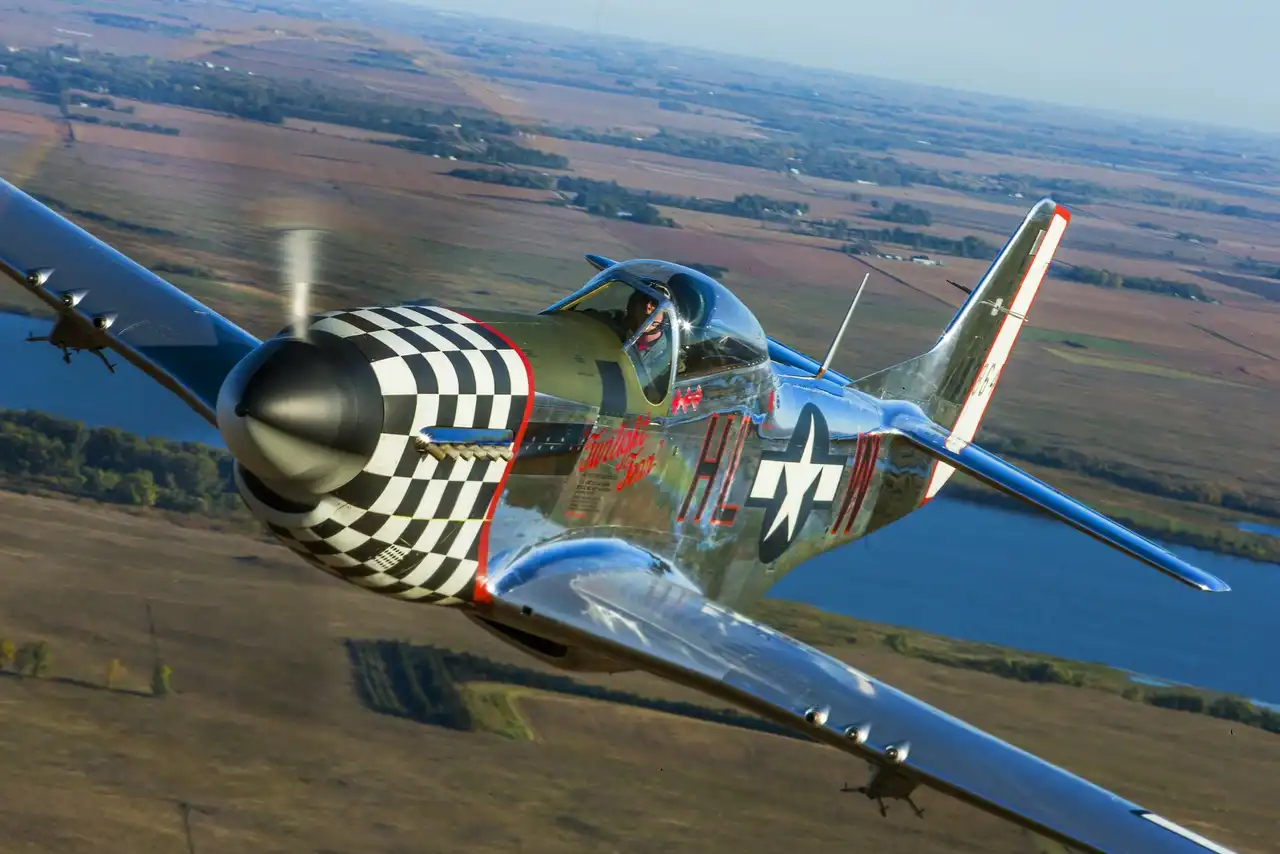
P-51 Mustang: The Fighter That Redefined Air Combat
Few aircraft carry as much weight in military aviation history as the North American P-51 Mustang. Born from a wartime request and delivered in record time, this single-engine fighter went on to become one of the most decisive weapons of the Allied air campaign in World War II — and it kept flying combat missions well into the 1950s over Korea.
What set the Mustang apart wasn’t just speed. It was the rare combination of long range, high-altitude performance, and firepower that let it do something few other fighters of its era could: fly deep into enemy territory and fight effectively once it got there.
Where It All Began
The story starts in April 1940, when the British Purchasing Commission approached North American Aviation (NAA) about building the existing Curtiss P-40 under license. Instead, NAA proposed something bolder: an entirely new fighter design. The result was the NA-73X prototype, built and flown in just 120 days — an almost unheard-of turnaround for the aviation industry at the time.
Britain received the first production models, known as the Mustang I, in 1941. The U.S. Army Air Forces followed with a small number of test aircraft designated XP-51, but the fighter hadn’t yet found its true calling. That would take a change under the hood.
The Engine Swap That Changed Everything
Early Mustangs ran on the American-built Allison V-1710 engine, which performed well at low altitude but lost significant power above roughly 15,000 feet — precisely where the war’s most important air battles were being fought. The fix came from an unlikely source: the British Rolls-Royce Merlin, a liquid-cooled V12 engine later built in the U.S. under license by Packard.
That single change transformed the aircraft. High-altitude performance jumped dramatically, and the resulting P-51B variant entered combat in 1943, finally giving American bombers an escort capable of accompanying them all the way to targets deep inside Germany.
The P-51D: The Definitive Version
By 1944, the most-produced and most recognizable variant had arrived: the P-51D. It introduced a bubble canopy that gave pilots a full 360-degree field of view — a major improvement over earlier “razorback” designs with limited rear visibility — along with an upgraded armament package of six .50-caliber machine guns mounted in the wings.
The aerodynamic design deserves equal credit. The Mustang’s wings used a laminar-flow airfoil, a cutting-edge concept developed by NACA (the predecessor to NASA) that reduced surface drag and boosted efficiency. Beneath the fuselage, the radiator setup took advantage of what’s known as the Meredith Effect: heated air exiting the cooling system was channeled to produce a small amount of forward thrust, partially offsetting the drag the radiator itself created.
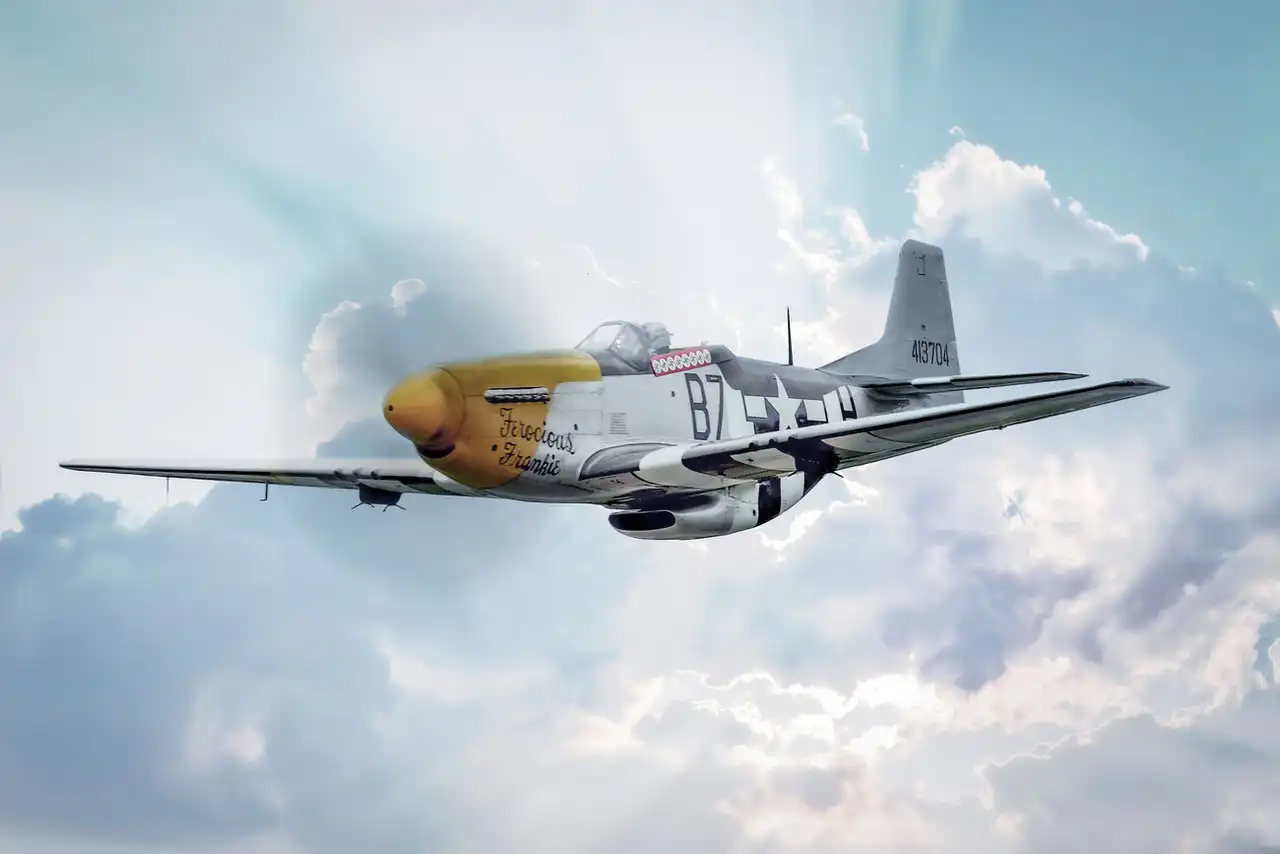
P-51D Technical Specifications
| Specification | Value |
|---|---|
| Length / Wingspan | 32 ft 3 in / 37 ft |
| Engine | Packard V-1650-7 (Merlin) |
| Power output | 1,695 hp |
| Top speed | 437 mph |
| Range (with drop tanks) | up to 2,003 miles |
| Service ceiling | 41,900 ft |
These numbers explain why the Mustang became so valuable to Allied planners. It could escort heavy bombers like the B-17 on missions deep into hostile airspace — a capability no other Allied fighter matched at the time.
Firepower and Combat Load
The P-51D carried six M2 Browning .50-caliber machine guns in the wings, along with the option to mount up to ten 5-inch HVAR rockets or as much as 2,000 pounds of bombs when flying ground-attack missions. The K-14 gyroscopic gunsight, introduced with this variant, helped pilots calculate deflection shots more accurately during high-speed maneuvering combat, reducing reliance on guesswork.
Combat Performance and Operational Record
Over Europe, the Mustang played a central role in Operation Pointblank, providing long-range escort for B-17 and B-24 bomber formations on deep-penetration raids into Germany. By war’s end, Mustang squadrons had claimed roughly 4,950 aerial victories — the highest total of any American fighter type in the European theater.
In the Pacific, Mustangs escorted B-29 bombers on missions toward the Japanese home islands. During the Korean War, from 1950 to 1953, the aircraft shifted primarily to close air support for ground troops, as the arrival of jet fighters like the MiG-15 had already made piston-engine fighters obsolete for air-to-air combat.
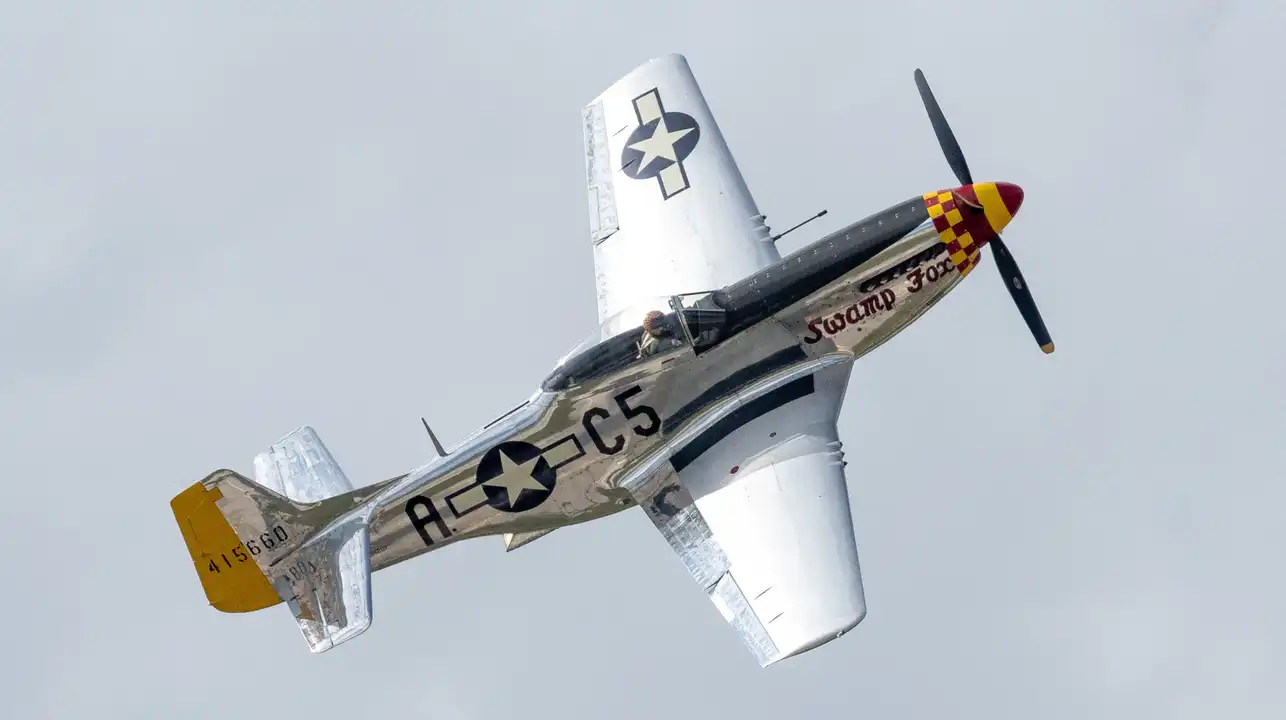
Strengths and Weaknesses
Strengths:
- Exceptional range for long-distance bomber escort
- Strong high-altitude performance after the Merlin engine swap
- Full visibility with the bubble canopy design
- Effective firepower from six .50-caliber guns
Weaknesses:
- Liquid-cooled radiator vulnerable to damage, especially from ground fire
- Less battle damage tolerance than radial-engine fighters
- Handling instability when the rear fuselage fuel tank was full
- Laminar-flow wings sensitive to dirt, ice, or surface imperfections, which reduced real-world performance
P-51 Mustang vs Focke-Wulf Fw 190: The Direct Rival
The Fw 190 was one of the Mustang’s toughest opponents over Europe. The P-51 held a clear edge at high altitude and in sustained vertical turns, while the German fighter was more agile at lower altitudes and in fast, snap maneuvers.
| Category | P-51 Mustang | Fw 190 |
|---|---|---|
| Key strength | Range and altitude performance | Low-altitude agility |
| Engine type | Liquid-cooled | Air-cooled |
Against the British Spitfire, the difference was more about design philosophy. The Mustang was built around minimizing drag for maximum range, while the Spitfire prioritized tight turning performance for shorter-range home-defense missions.
Variants and Postwar Legacy
Beyond the P-51D, North American produced the P-51K (fitted with a different propeller), the lightweight P-51H intended for the Pacific theater (which never saw combat), and the F-82 Twin Mustang, an unusual design combining two modified Mustang fuselages. Total production is estimated between 14,819 and 14,855 aircraft, at a unit cost of roughly $54,000 at the time. After the war, the design influenced later projects like the Cavalier Mustang and the turboprop Piper PA-48 Enforcer, though neither reached large-scale production.
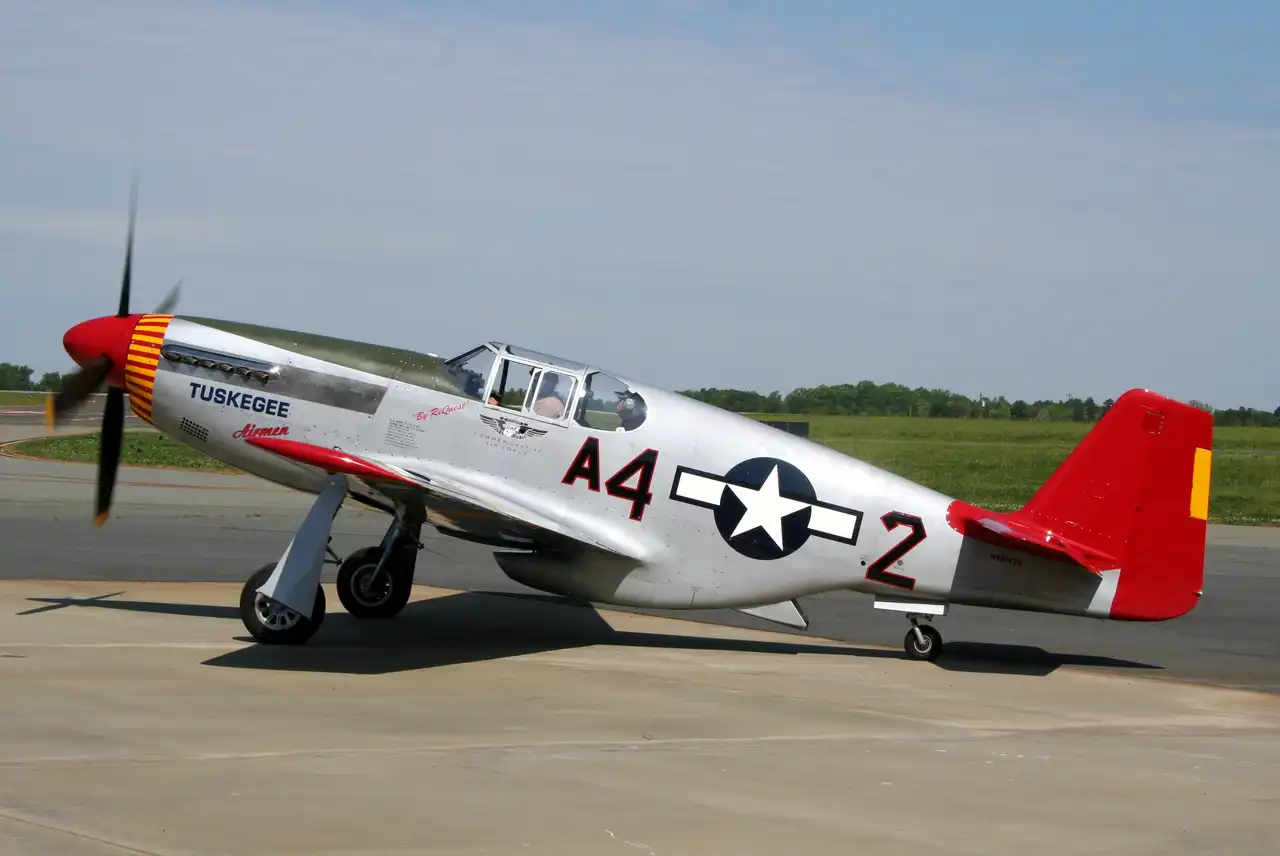
Lesser-Known Facts
- The Mustang was among the first Western fighters to use laminar-flow wing design at scale from the outset of development.
- Its cooling system doubled as a mild thrust generator thanks to the Meredith Effect.
- Despite being an American icon, its greatest performance leap came from a British engine.
Frequently Asked Questions
Is the P-51 Mustang still in military service?
No. It now flies only with private collectors, warbird operators, and museums.
What was the main difference between the Allison and Merlin engines?
The Allison performed well at low altitude, while the supercharged Merlin maintained power at high altitude, where the war’s key air battles took place.
How many enemy aircraft did the P-51 shoot down in WWII?
Mustang squadrons are credited with roughly 4,950 aerial victories in the European theater alone.
Did the P-51 fight in the Korean War?
Yes, primarily in close air support roles, since jet fighters had taken over the air-to-air combat mission.
What was the Mustang’s biggest weakness?
Its liquid-cooled radiator system, which was vulnerable to ground fire and could disable the aircraft with relatively minor damage.
The Bottom Line
The P-51 Mustang combined range, speed, and firepower in a way no other WWII-era fighter matched, making it decisive in securing Allied air superiority over Europe. Despite its vulnerable cooling system, its overall balance of performance cemented its place as one of the most important fighter aircraft in aviation history.

Joseli Lourenço
07/21/2026