
Built Bigger, Deadlier, Smarter: The Real Story Behind the Super Hornet
The F/A-18 Super Hornet is the U.S. Navy’s primary carrier-based strike fighter. Versatile, combat-proven, and still evolving, it remains one of the most capable naval aircraft flying today.
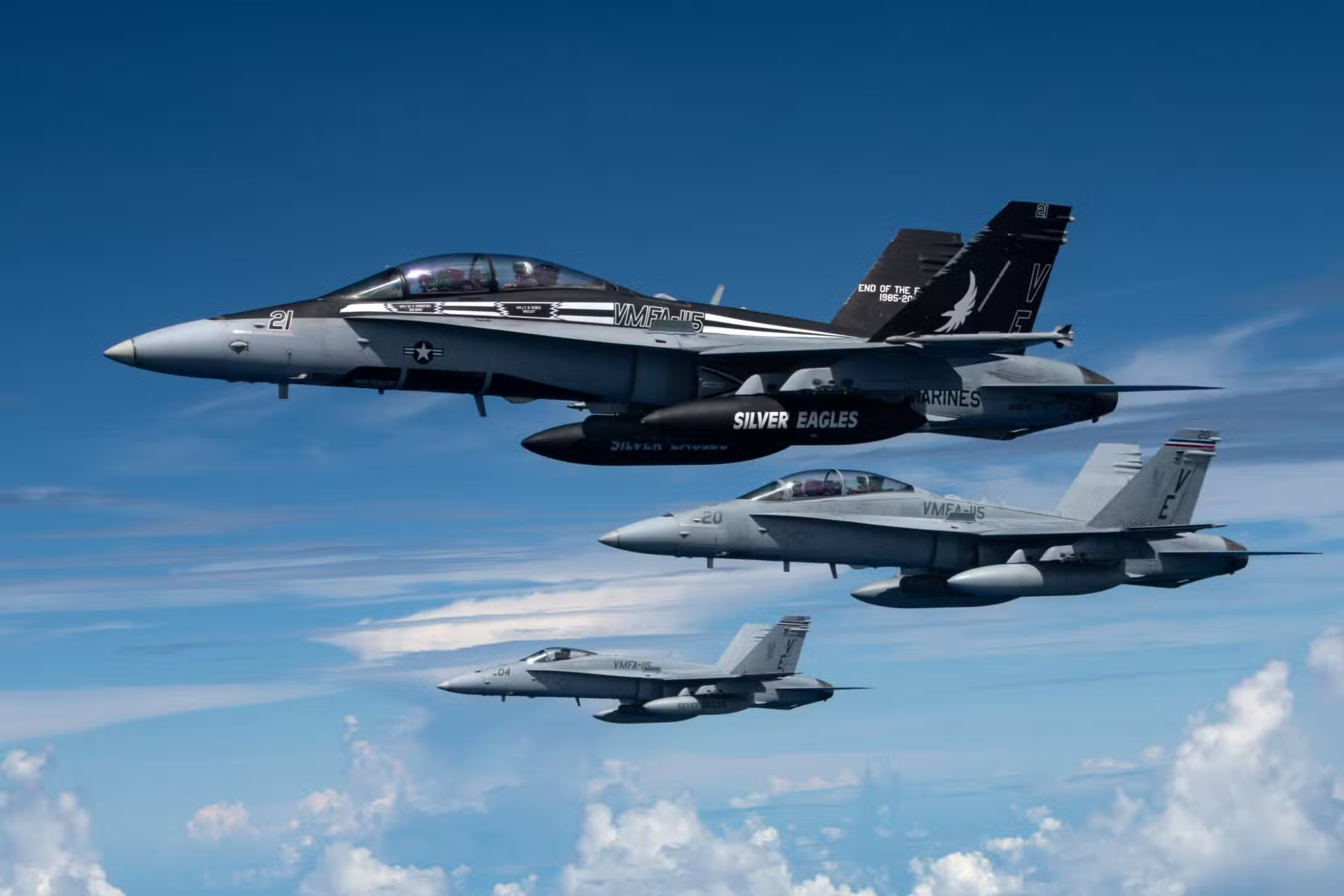
F/A-18 Super Hornet: The Fighter the U.S. Navy Can’t Let Go
The F/A-18 Super Hornet is a twin-engine, multirole fighter aircraft designed to operate from aircraft carriers. It can strike ground targets with precision, engage enemy aircraft, suppress hostile air defenses, and gather battlefield intelligence — often on the same mission.
Introduced into U.S. Navy service in 1999, the Super Hornet was built to fill gaps left by aging aircraft and a canceled program that never made it past development. More than two decades later, with the fifth-generation F-35C arriving on flight decks, the Super Hornet is still flying, still being upgraded, and still at the center of American carrier aviation.
That staying power isn’t an accident.
Where It Came From: The Program That Built a Legacy
A Bigger, Better Hornet
The Super Hornet didn’t emerge from a blank sheet of paper. It evolved from the F/A-18 Hornet, a fighter that first flew in the late 1970s and was built by McDonnell Douglas — a company later absorbed by Boeing in 1997.
The original Hornet was a capable aircraft, but it had real weaknesses: limited combat range, a modest payload, and avionics that were becoming dated by the early 1990s. When the U.S. Navy’s A-12 Avenger II stealth attack program collapsed in 1991 — canceled due to massive cost overruns and schedule failures — the service needed a replacement fast.
Rather than starting over, the Navy chose to scale up and redesign the Hornet significantly. The airframe grew by roughly 25 percent. The wings were widened. New, more powerful engines were selected. Fuel capacity increased substantially. The result was a genuinely different aircraft that happened to share a name with its predecessor — a political decision that helped smooth congressional approval at the time.
The Super Hornet completed its first flight in November 1995. Boeing delivered the first operational aircraft to the Navy in 1999, and the type flew its first combat missions just two years later.
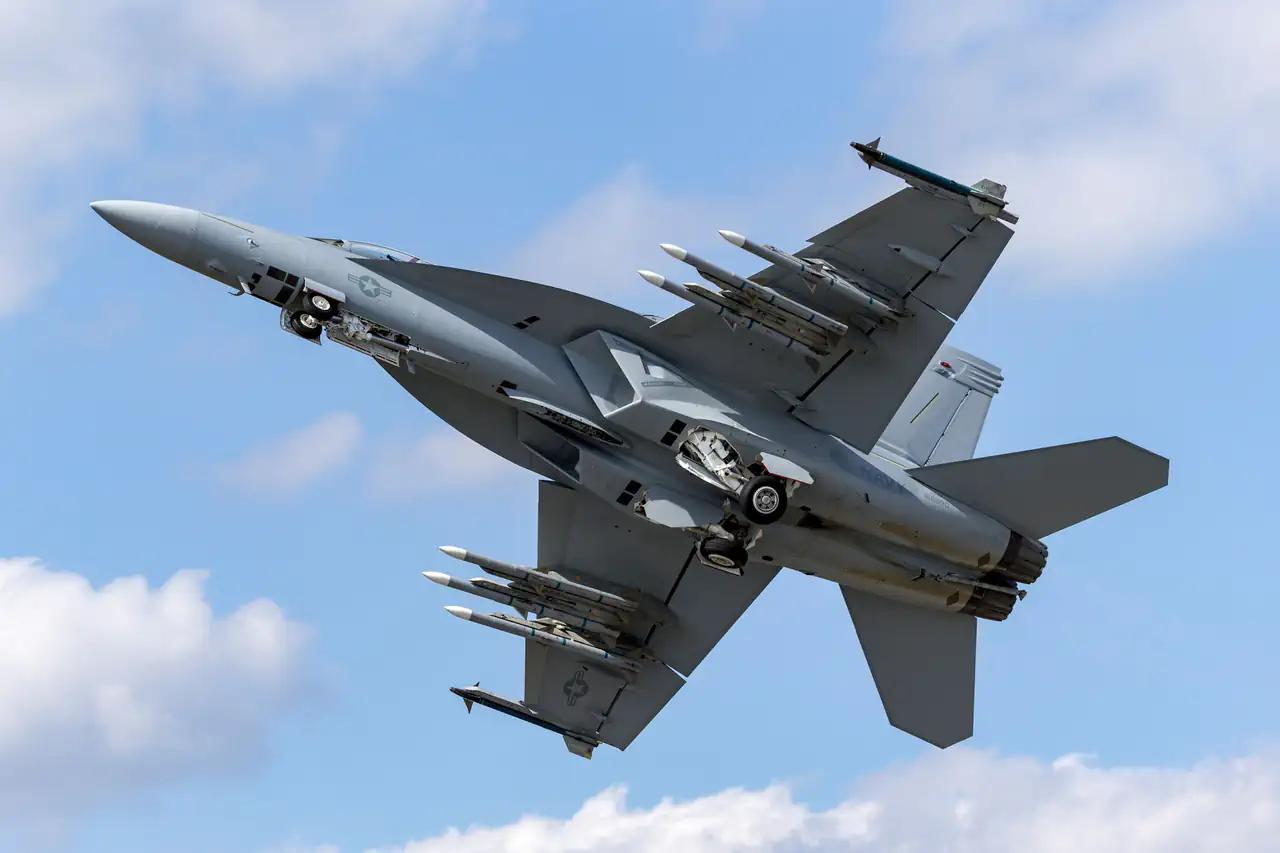
Under the Skin: Technology, Sensors, and What Makes It Tick
Airframe and Flight Characteristics
The Super Hornet uses a blended delta-wing design with large leading-edge root extensions — known as LEX — along the fuselage. These generate additional lift at lower speeds, which is critical for carrier operations where aircraft must land slowly and precisely on a very short runway.
Power comes from two General Electric F414-GE-400 turbofan engines, each producing roughly 98 kilonewtons of thrust with afterburner. That gives the aircraft a top speed of approximately Mach 1.8, or around 1,190 miles per hour. It’s not the fastest fighter in the sky, but speed is only one part of what makes a naval strike aircraft effective.
Radar and Avionics
The APG-79 AESA radar — Active Electronically Scanned Array — is one of the most important upgrades the Super Hornet received over earlier Hornet variants. Unlike older mechanically-scanned radars, AESA systems can track multiple targets simultaneously, switch between air-to-air and air-to-ground modes almost instantly, and are significantly harder to jam or detect.
The cockpit uses multi-function displays and a HOTAS setup — Hands On Throttle And Stick — which allows pilots to manage weapons, sensors, and navigation without removing their hands from the flight controls. In high-threat environments, that matters enormously.
For targeting, the aircraft typically carries the ATFLIR pod — Advanced Targeting Forward-Looking Infrared — which provides high-resolution imagery for identifying and engaging ground targets day or night.
The EA-18G Growler: Electronic Warfare Variant
One of the most operationally significant aircraft to emerge from the Super Hornet program is the EA-18G Growler. Built on the two-seat F/A-18F airframe, the Growler replaces conventional weapons with advanced electronic warfare systems designed to jam enemy radar, disrupt communications, and suppress air defense networks.
It’s the only dedicated carrier-based electronic attack aircraft currently in U.S. service and flies alongside Super Hornets on nearly every major strike mission.
Weapons Load: What the Super Hornet Brings to a Fight
The Super Hornet has eleven external hardpoints — attachment points for weapons and equipment — giving it significant flexibility in how it’s configured for different mission types.
Air-to-air weapons include:
- AIM-120 AMRAAM — a radar-guided, beyond-visual-range missile capable of engaging targets at extended distances
- AIM-9X Sidewinder — a highly agile short-range missile used for close-in engagements
Air-to-ground and anti-ship weapons include:
- JDAM-guided bombs using GPS guidance for precision strikes
- AGM-88 HARM — a missile specifically designed to home in on and destroy enemy radar systems
- AGM-84 Harpoon — an anti-ship missile for engaging surface vessels
An internal M61A2 Vulcan 20mm rotary cannon with 578 rounds is also fitted for close-range aerial engagements.
Maximum external payload is approximately 17,750 pounds — a significant load for a carrier aircraft. That number reflects the platform’s ability to handle a wide spectrum of mission types without requiring extensive reconfiguration between sorties.
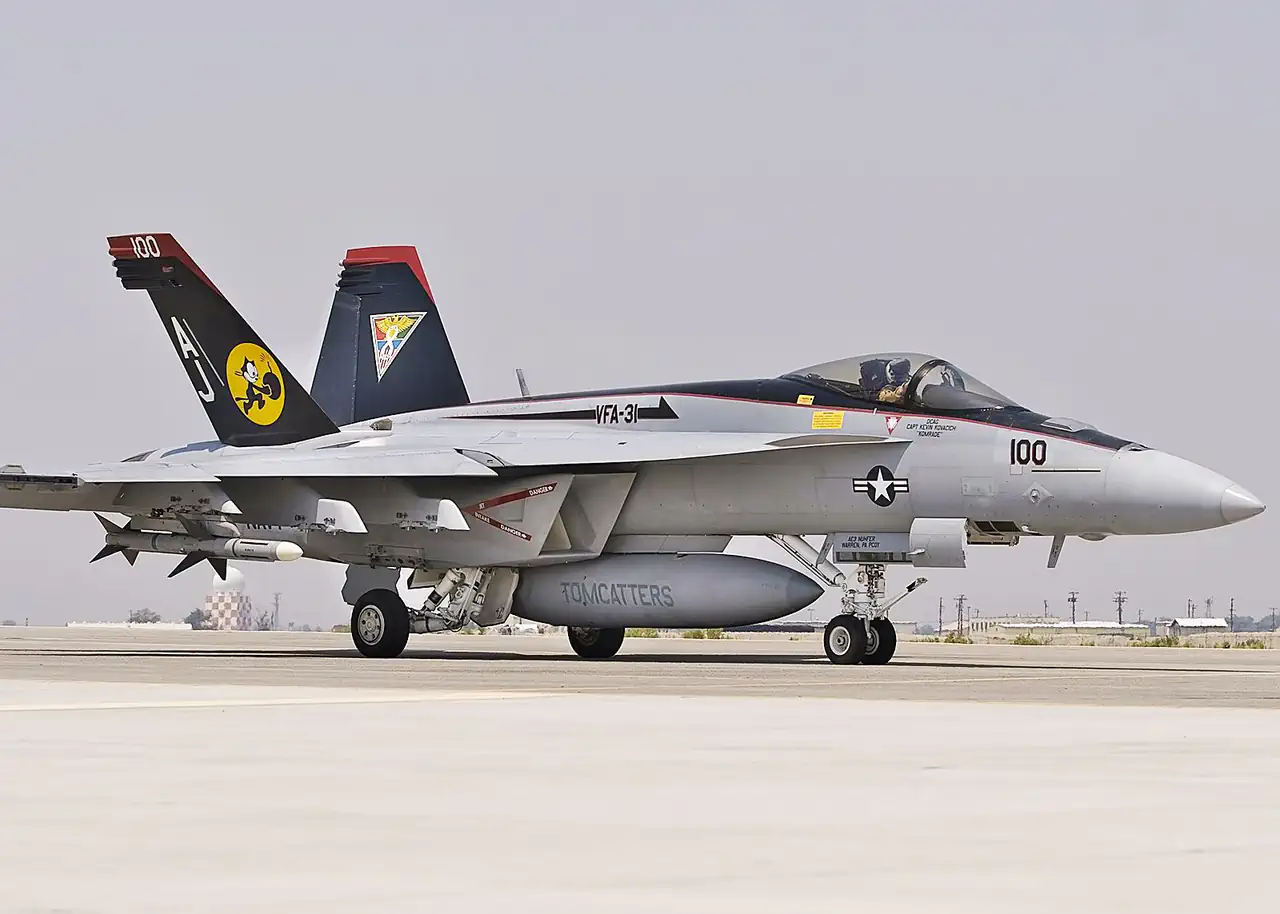
Combat History: Where the Super Hornet Has Actually Been Used
The Super Hornet entered combat operations in October 2001, supporting the initial phase of operations in Afghanistan. It followed that with strikes during the 2003 invasion of Iraq, and has continued flying combat missions across the Middle East in the years since — including operations against ISIS targets in Syria and Iraq beginning in 2014.
Australia also operates the Super Hornet. The Royal Australian Air Force acquired 24 F/A-18F aircraft as a bridging solution while waiting for its F-35A fleet to reach operational status. Australia also operates a small number of EA-18G Growlers, making it one of only two nations to fly the electronic warfare variant alongside the United States.
Super Hornet vs. F-35C: An Honest Comparison
| Feature | F/A-18 Super Hornet | F-35C |
|---|---|---|
| Generation | 4th / 4.5th | 5th |
| Stealth capability | Minimal | High |
| Cost per flight hour | ~$11,000 | ~$35,000 |
The F-35C represents a generational leap in stealth and sensor fusion. But the Super Hornet carries a larger external weapons load, costs significantly less to operate, and is considerably easier to maintain in the demanding environment of a carrier flight deck.
In a sustained high-tempo conflict, those operational cost differences add up quickly. That’s part of why the Navy has continued funding Super Hornet upgrades even as F-35C deliveries accelerate.
Variants: The Super Hornet Family
F/A-18E — single-seat variant, the most widely operated version in the U.S. Navy fleet.
F/A-18F — two-seat variant used for training and missions requiring a dedicated weapons systems officer.
EA-18G Growler — electronic warfare platform derived from the F/A-18F airframe.
Block III — the current modernization standard, featuring an upgraded digital cockpit, improved networking capability, and conformal fuel tanks that extend range without consuming external hardpoints.
Technical Specifications at a Glance
| Specification | Detail |
|---|---|
| Length | 60.3 ft (18.38 m) |
| Wingspan | 44.7 ft (13.62 m) |
| Max takeoff weight | ~66,000 lb (29,937 kg) |
| Top speed | Mach 1.8 (~1,190 mph) |
| Combat radius | ~460 miles (without refueling) |
| Service ceiling | 50,000 ft (15,240 m) |
| Engines | 2× GE F414-GE-400 |
Strengths and Weaknesses
Where it excels:
- Proven versatility across air-to-air, strike, and electronic warfare roles
- Strong combat track record over more than two decades of operations
- Lower operating costs compared to fifth-generation alternatives
- Well-suited to carrier maintenance environments
Where it falls short:
- Limited low-observable capability against advanced radar systems
- Combat radius without aerial refueling is modest for long-range strike missions
- Against true fifth-generation fighters in a contested environment, it operates at a disadvantage
Things Worth Knowing
The Super Hornet is physically 25 percent larger than the original Hornet, but was deliberately kept under the same family name to ease its passage through congressional budget reviews in the 1990s — a detail that illustrates how procurement politics can shape aviation history.
The 2022 film Top Gun: Maverick featured real F/A-18 Super Hornets during its aerial sequences, with cast members flying in the aircraft as backseat passengers. The production worked closely with the U.S. Navy to capture genuine flight footage.
Despite repeated projections that the type would wind down as F-35C deliveries increased, budget constraints and production delays have consistently extended the Super Hornet’s service life. It is currently expected to remain operational into the 2030s.
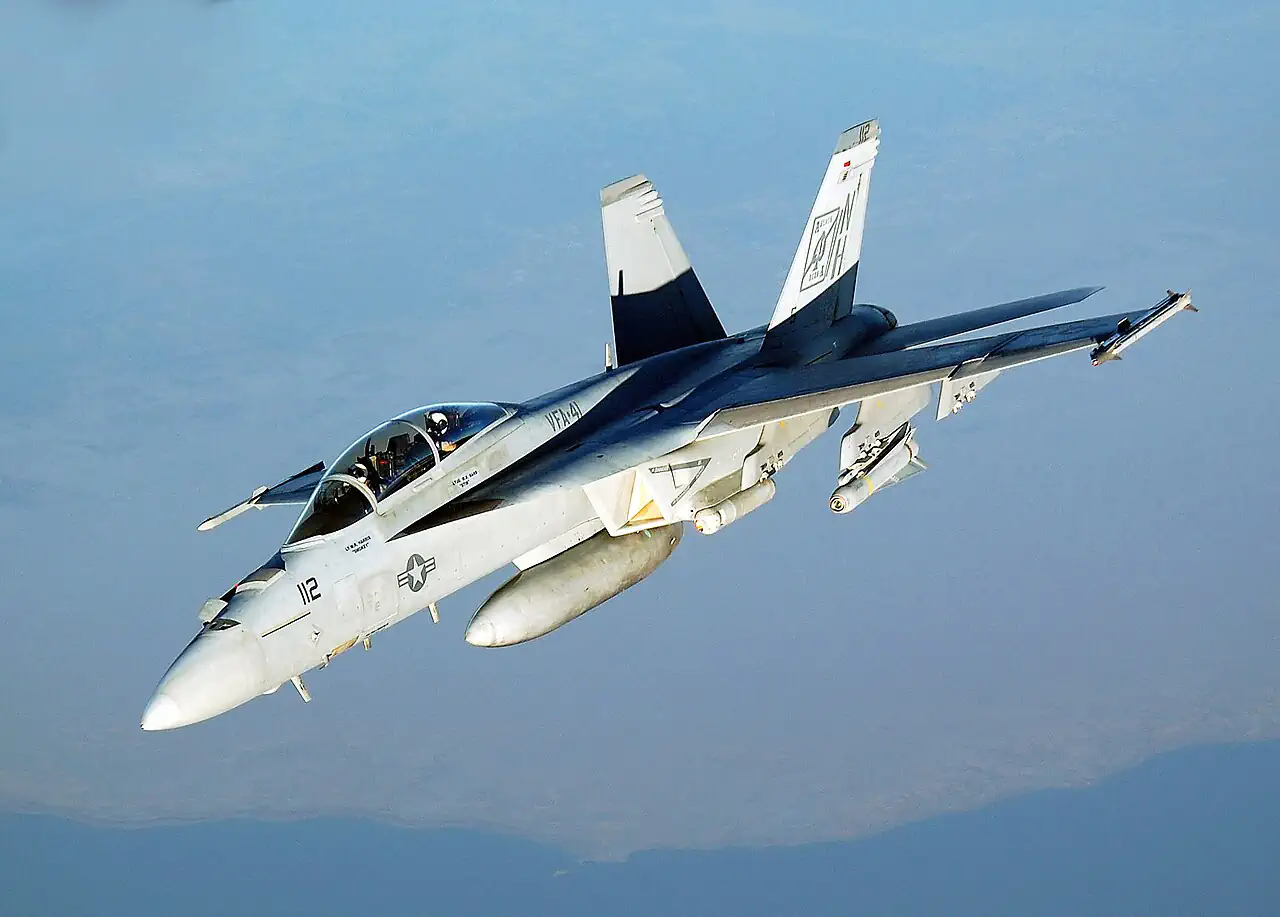
Frequently Asked Questions
Is the F/A-18 Super Hornet still in production?
Yes. Boeing continues to produce Super Hornets and is actively delivering Block III upgrades to the U.S. Navy.
What’s the difference between the Hornet and the Super Hornet?
The Super Hornet is a substantially redesigned aircraft — larger, heavier, more powerful, and equipped with more advanced systems. They share a name but are not the same jet.
Does Australia operate the Super Hornet?
Yes. The Royal Australian Air Force flies both the F/A-18F Super Hornet and the EA-18G Growler, acquired as a transitional fleet ahead of its F-35A program.
How much does a Super Hornet cost?
Approximately $67 million per unit, though final pricing varies depending on configuration and contract terms.
Will the F-35C replace the Super Hornet entirely?
Partially. F-35Cs are entering service alongside Super Hornets, but a full replacement is not expected before the early 2030s at the earliest.
Final Assessment
The F/A-18 Super Hornet is a textbook example of smart, sustained evolution. It was never designed to be the most advanced fighter of its generation — it was designed to be the most useful one. Two decades of combat operations, continuous upgrades, and a lower operational cost than its fifth-generation successors have kept it firmly at the center of U.S. carrier aviation. It isn’t invisible to radar and it isn’t the fastest jet in the sky, but it’s reliable, lethal, and still very much in the fight.

Joseli Lourenço
06/25/2026