
Why the A-10 Thunderbolt II is the Ultimate Nightmare for Enemy Tanks
Meet the A-10 Thunderbolt II, the U.S. Air Force’s legendary tank killer. Discover how its titanium armor and fearsome GAU-8 cannon made the “Warthog” an immortal icon of close air support in combat.
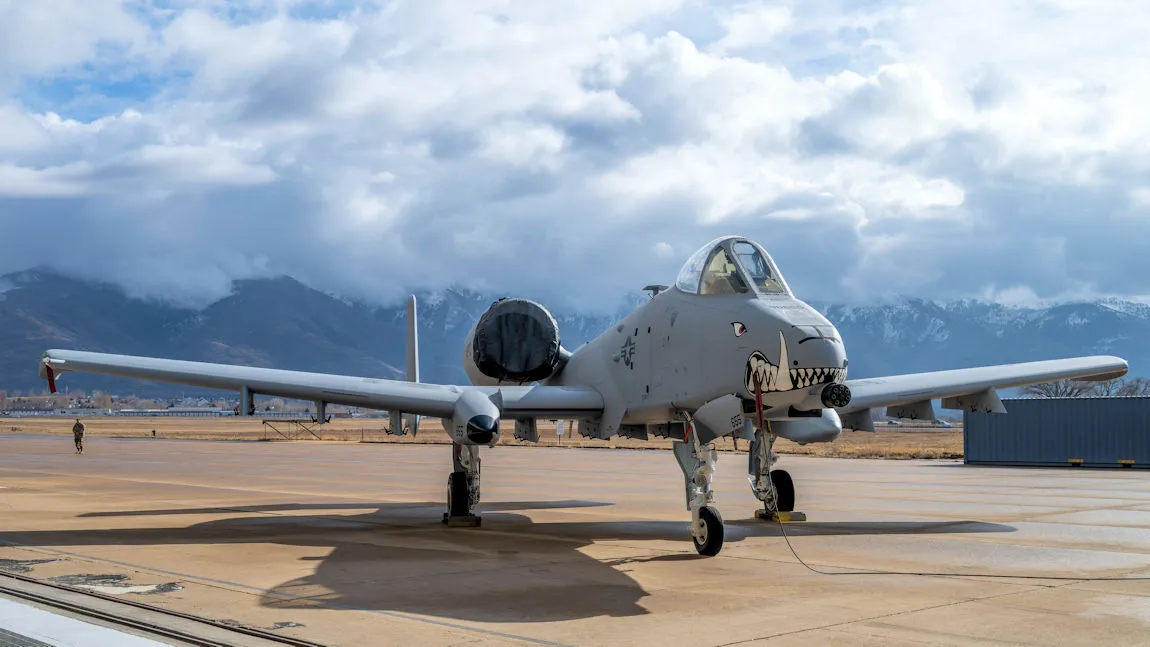
Few sounds on the modern battlefield are as distinctive or terrifying as the tearing roar of the A-10 Thunderbolt II. Affectionately known as the “Warthog,” this aircraft was never meant to be fast or sleek. Instead, it was engineered as a highly survivable, devastatingly lethal tool for Close Air Support (CAS).
Renowned for its ability to absorb heavy enemy fire and its massive 30mm nose-mounted cannon, the A-10 stands as the ultimate guardian of ground troops. Its historical impact was solidified across the Middle East, proving that rugged durability and raw firepower often outmatch supersonic speed in the grit of ground combat.
OVERVIEW
The A-10 Thunderbolt II is a twin-engine, straight-wing jet designed specifically for ground attack. Developed in the United States by Fairchild Republic, its primary function is Close Air Support. This means the aircraft operates directly above friendly ground forces, eliminating immediate enemy threats like main battle tanks, armored personnel carriers, and fortified bunkers.
Born during the Cold War era, the aircraft was the American answer to the massive Soviet armored columns stationed in Eastern Europe. It was built to destroy armor in large numbers while surviving the dense anti-aircraft environments typical of the European theater.
HISTORY AND DEVELOPMENT
The A-10 traces its roots back to the A-X (Attack Experimental) program of the late 1960s. The U.S. Air Force had learned harsh lessons during the Vietnam War: fast jets like the F-4 Phantom struggled to provide slow, accurate ground support, while older piston-engine planes like the A-1 Skyraider were highly vulnerable to modern surface-to-air threats.
The geopolitical climate demanded a dedicated tank-killer capable of low-altitude operations under intense fire. Fairchild Republic competed against Northrop’s YA-9 prototype and won the contract in 1973. Following rigorous testing, the A-10 officially entered service in 1976. Over the decades, it has undergone massive avionics upgrades to maintain its lethal edge in 21st-century warfare.
DESIGN AND TECHNOLOGY
The design philosophy of the A-10 is uniquely pragmatic: the aircraft was literally built around its massive cannon.
Structure and Armor: The pilot is encased in a 1,200-pound “titanium bathtub” that can withstand direct hits from 23mm armor-piercing projectiles.
Aerodynamics: Its large, straight wings sacrifice supersonic speed for exceptional maneuverability at low speeds and altitudes, allowing for highly accurate weapon delivery.
Electronic Systems: Modern A-10s feature glass cockpits, Helmet Mounted Cueing Systems (HMCS), and advanced data links.
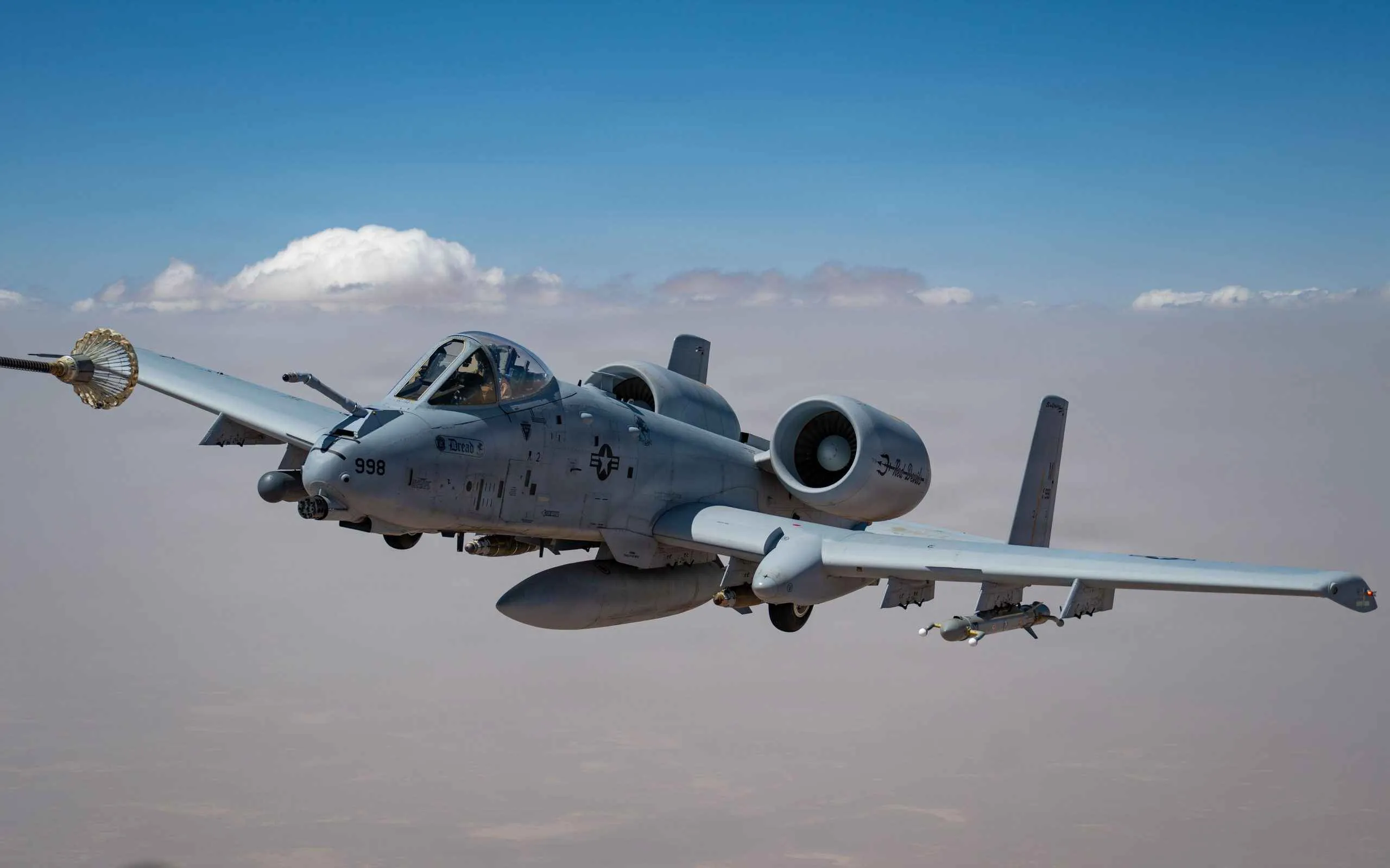
Sensors and Targeting: Equipped with advanced Targeting Pods (like the Sniper XR or LITENING), the A-10 can identify, track, and engage targets day or night, and in adverse weather.
Protection Systems: Redundant hydraulic flight-control systems are backed by a manual mechanical system. If hydraulics fail completely, the pilot can still fly the aircraft using cables and pulleys.
ARMAMENT
The lethality of the A-10 Thunderbolt II is unmatched in the CAS role.
Primary Weapon: The seven-barrel GAU-8/A Avenger 30mm Gatling cannon. Firing at an astonishing rate of 3,900 rounds per minute, it uses depleted uranium armor-piercing incendiary rounds that slice through heavy armor with ease.
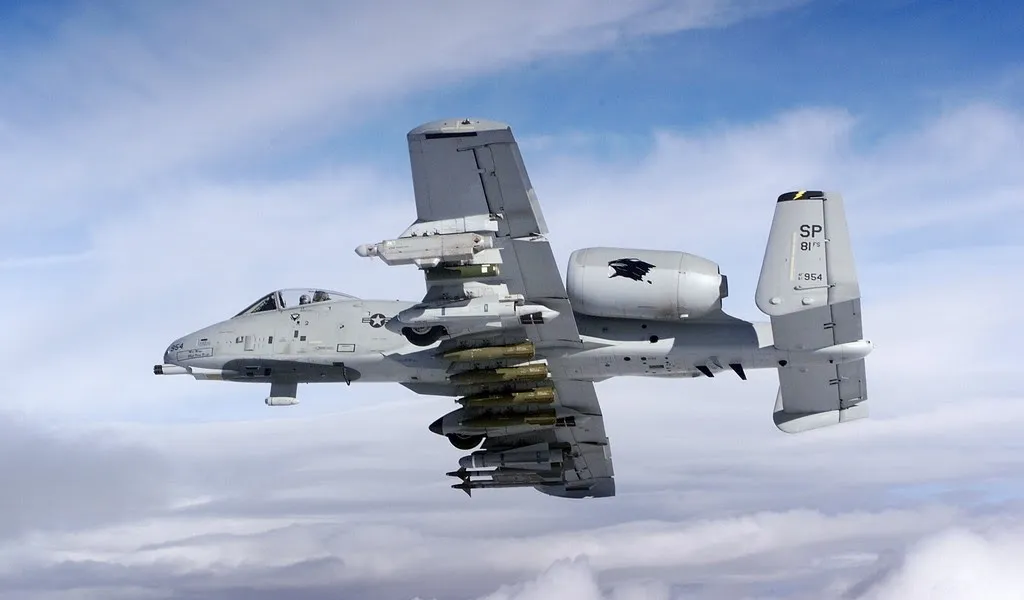
Secondary Weapons: With 11 hardpoints, the A-10 carries a massive payload. It deploys AGM-65 Maverick air-to-surface missiles for standoff anti-armor capabilities, alongside laser-guided bombs (Paveway series), JDAMs, and Hydra 70 unguided rockets.
Offensive Capacity: The sheer volume of ordnance allows a single A-10 to systematically dismantle an entire enemy convoy in a single sortie.
PERFORMANCE
Unlike traditional fighter jets, the A-10 does not rely on speed to survive.
Speed: Its top speed is roughly 439 mph (Mach 0.56).
Operational Range: It boasts an impressive combat radius of 250 miles, with a massive loiter time.
Loiter Capability: The aircraft is designed to stay over the battlefield for extended periods—up to two hours—waiting for the perfect moment to strike.
Operational Efficiency: The Warthog can take off and land from short, unpaved, or battle-damaged runways close to the front lines.
TECHNICAL SPECIFICATIONS
| Feature | Specification |
| Country of Origin | United States |
| Manufacturer | Fairchild Republic |
| Introduction Year | 1976 |
| Crew | 1 pilot |
| Weight | 24,959 lbs (empty) / 50,000 lbs (max takeoff) |
| Length | 53 ft 4 in (16.26 m) |
| Wingspan | 57 ft 6 in (17.53 m) |
| Height | 14 ft 8 in (4.47 m) |
| Maximum Speed | 439 mph (~706 km/h) |
| Combat Radius | 250 miles (400 km) |
| Primary Armament | 1x 30mm GAU-8/A Avenger Gatling cannon |
| Secondary Armament | AGM-65 missiles, guided/unguided bombs, rockets |
| Powerplant | 2x General Electric TF34-GE-100A turbofans |
| Thrust | 9,065 lbf per engine |
| Operational Status | Active (USAF) |
COMBAT HISTORY AND WARS
The A-10 achieved global fame during the 1991 Gulf War. During Operation Desert Storm, Warthogs destroyed over 900 Iraqi tanks, 2,000 military vehicles, and 1,200 artillery pieces, suffering minimal losses.
It later proved invaluable during the Balkans conflicts, the War in Afghanistan, and the 2003 invasion of Iraq. More recently, the A-10 played a critical role in Operation Inherent Resolve, decimating terrorist strongholds and providing dangerously close support to friendly forces pinned down by enemy fire.
ADVANTAGES
Extreme Survivability: The aircraft can sustain catastrophic damage—such as losing one engine, half its tail, and part of a wing—and still fly the pilot safely home.
Loiter Time: Its ability to circle a target area for hours provides constant cover for ground infantry.
Devastating Firepower: The psychological and physical destruction caused by the GAU-8 cannon is unparalleled.
DISADVANTAGES
Low Speed: Flying low and slow makes the A-10 vulnerable to advanced, modern Surface-to-Air Missiles (SAMs) and MANPADS.
Lack of Air-to-Air Capability: While it carries AIM-9 Sidewinder missiles for self-defense, the A-10 cannot dogfight. It relies heavily on air superiority established by fighters like the F-15 or F-22.
COMPARISON WITH COMPETITORS
The closest equivalent to the A-10 is the Russian Sukhoi Su-25 “Frogfoot”.
Design: Both are heavily armored, twin-engine ground-attack jets.
Performance: The Su-25 is faster (reaching nearly 600 mph) but has a significantly shorter combat radius and lower payload capacity.
Technology: The A-10’s avionics, targeting pods, and precision-guided munition integration generally surpass the standard Su-25 variants.
Armament: While the Su-25 mounts a deadly 30mm twin-barrel cannon, it lacks the extreme armor-penetrating power, ammunition capacity, and accuracy of the A-10’s GAU-8.
VARIANTS AND MODERNIZATIONS
A-10A: The original production variant, featuring analog flight instruments and rudimentary targeting systems.
A-10C: The definitive modern upgrade. It introduced a full glass cockpit, digital stores management, integration of GPS-guided smart weapons (JDAMs), and advanced data link capabilities for precise battlefield communication.
Upgrades: The fleet continually undergoes the A-10 Wing Replacement Program (WRP) to combat structural fatigue and keep the aircraft airworthy into the late 2020s.
CURIOSITIES
The aircraft was literally designed around the gun; engineers first positioned the GAU-8 cannon and built the airframe to support it.
The iconic “Brrrrt” sound is heard after the target is hit because the 30mm rounds travel faster than the speed of sound.
The engines are mounted high and wide on the fuselage to mask their infrared heat signature from ground-based heat-seeking missiles.
When the main landing gear is retracted, the tires protrude slightly from the wings, allowing for a safer belly landing if the gear fails.
The recoil of the GAU-8 is so powerful (roughly 10,000 pounds of force) that extended firing can actually slow the aircraft down mid-flight.
The cockpit windshield can withstand direct hits from 23mm anti-aircraft rounds.
During the Gulf War, A-10 pilots successfully shot down two enemy helicopters using only the main cannon.
The pilot boards the aircraft using a built-in retractable ladder, requiring no ground support equipment.
It earned the “Warthog” nickname because many pilots initially considered its blunt, utilitarian design to be ugly.
The U.S. Air Force has attempted to retire the A-10 multiple times, but Congress and ground forces consistently block the move due to the jet’s irreplaceable CAS capabilities.
IMPACT ON THE MILITARY WORLD
The A-10 Thunderbolt II essentially wrote the modern doctrine for Close Air Support. Its strategic influence extends beyond mere destruction; its distinct silhouette and the terrifying sound of its cannon serve as potent psychological warfare tools that shatter enemy morale. For military engineers globally, the Warthog remains the ultimate case study in how pragmatic, survivable design can completely dominate a specific operational niche.
(FAQ)
1. What does the “A” in A-10 stand for? It stands for “Attack,” which is the U.S. military designation for tactical aircraft designed primarily to attack ground targets.
2. Why does the A-10 make the “BRRRRT” sound? The sound is created by the extremely high firing rate of the GAU-8/A cannon combined with the sonic booms of the supersonic 30mm projectiles.
3. Is the A-10 Thunderbolt II still in service? Yes. While the U.S. Air Force is slowly divesting older airframes, upgraded A-10C models remain in active service.
4. Can the A-10 dogfight other fighter jets? No. It is purely a ground-attack aircraft. It would be severely outmatched in speed, maneuverability, and radar capabilities against dedicated air superiority fighters.
5. Why is the A-10 so slow? Its slow speed is a tactical advantage. It allows the pilot to visually identify friendly troops and enemy targets on the ground and deliver ordnance with pinpoint accuracy.
6. What is the A-10’s titanium bathtub? It is a 1,200-pound titanium armor shell that completely surrounds the lower half of the cockpit, protecting the pilot and critical flight controls from ground fire.
7. How many A-10s were built? A total of 716 aircraft were manufactured before production ended in 1984.
8. Can the A-10 fly with only one engine? Yes. The aircraft was engineered with extreme redundancy, allowing it to fly, maneuver, and land safely even if one engine is completely destroyed.
9. Will the F-35 replace the A-10? The F-35 Lightning II was slated to take over the CAS role. However, many military analysts argue the F-35 cannot match the A-10’s loiter time, massive payload, and ability to survive low-altitude damage.
10. What is the main target of the A-10? It is designed to destroy main battle tanks, armored personnel carriers, artillery units, and fortified enemy infantry positions.
The Enduring Legacy of the Armor Hunter
No other aircraft in the history of military aviation has executed its intended mission with the brutal efficiency of the A-10 Thunderbolt II. It stands as a flying testament to the fact that stealth and supersonic speeds cannot always replace heavy armor and sheer firepower in the chaos of close-quarters ground combat. The Warthog will forever be celebrated as the uncompromising machine that infantrymen could rely on when all other options failed.
Expand your knowledge of modern warfare engineering by exploring our deep dives into air superiority fighters and the evolution of defense technologies in today’s geopolitical landscape!

Joseli Lourenço
06/15/2026