
F-39 Gripen: Everything About the Brazilian Air Force’s New Fighter
Explore the Saab JAS 39 Gripen, Sweden’s advanced multi-role fighter operating in Brazil as the F-39. Discover its AESA radar, electronic warfare systems, Meteor missiles, specs, and rival comparisons.
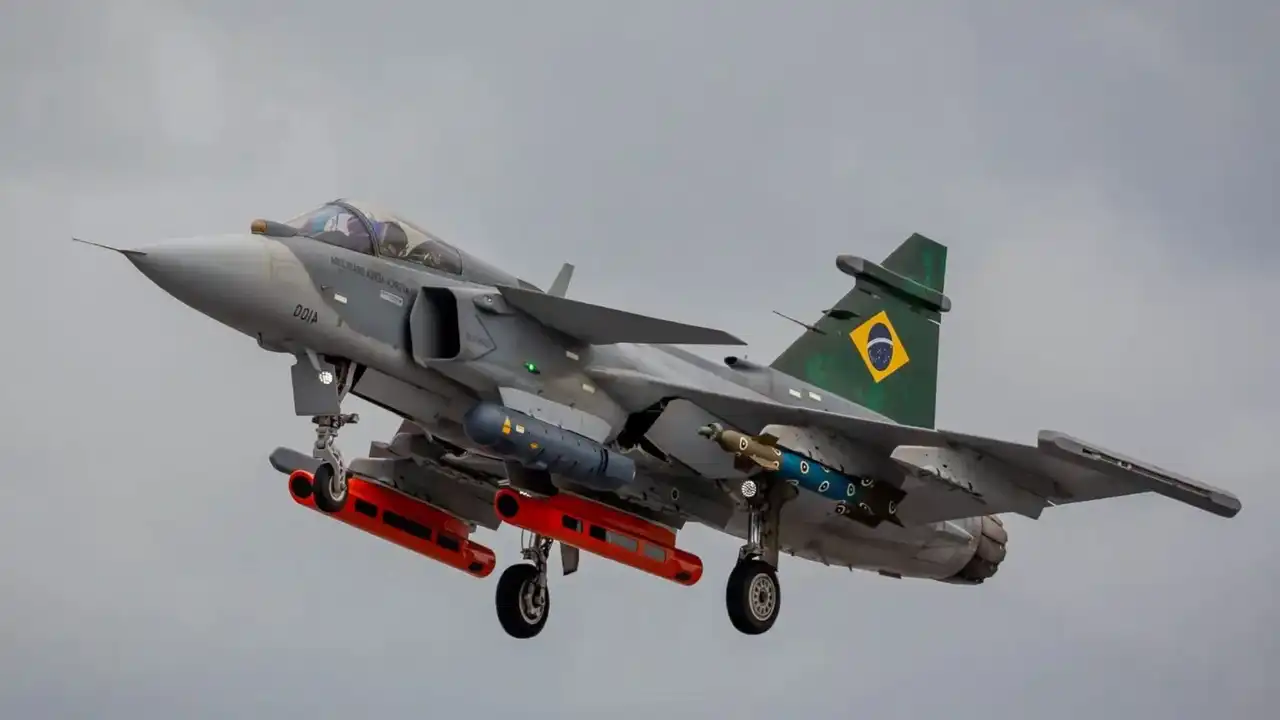
The Saab JAS 39 Gripen: How Sweden’s Fighter Became Brazil’s New F-39
What Is the JAS 39 Gripen?
The JAS 39 Gripen is a lightweight, single-engine, multi-role combat aircraft developed by the Swedish aerospace company Saab AB. The Swedish acronym JAS directly reflects its operational versatility: Jakt (Air-to-Air Combat), Attack (Air-to-Surface Strike), and Spaning (Reconnaissance). By integrating these three distinct capabilities into a single airframe, Saab engineered a platform that dramatically reduces lifecycle costs and streamlines logistics for operating air forces.
When the Brazilian Air Force (Força Aérea Brasileira, or FAB) selected the aircraft under its high-profile FX-2 modernization program, the fighter was officially designated as the F-39 Gripen, signaling a major technological leap for South America’s largest military.
Origin and Historical Context
The lineage of the Gripen traces back to the late 1970s, a Cold War era when Sweden needed a highly capable aircraft to replace its aging Saab 35 Draken and Saab 37 Viggen fleets. The development program was formally launched in 1980, culminating in the maiden flight of the first prototype in 1988. Following rigorous flight testing and system refinement, the first-generation JAS 39A officially entered service with the Swedish Air Force in 1997.
As global defense needs evolved, Saab introduced the JAS 39C/D variants. These upgraded models featured aerial refueling capabilities, English-language cockpit instrumentation, and full NATO interoperability, opening the door to international export sales to nations such as Hungary, the Czech Republic, Thailand, and South Africa.
From Gripen NG to the Gripen E/F
To keep pace with emerging stealth threats and advanced air defense networks, Saab unveiled the Gripen Demonstrator concept in 2007. This testbed laid the groundwork for the next-generation Gripen E/F (formerly referred to as the Gripen NG). Featuring a larger fuselage, a more powerful engine, and a revolutionary avionics architecture, the Gripen E completed its first flight on June 15, 2017, and reached initial operational readiness with the Swedish Air Force in 2021.
Brazil cemented its role as a key player in the program in 2014 by signing a contract for 36 Gripen E/F fighters under the FX-2 program. Today, Brazil and Sweden stand as the primary joint operators and technological drivers of this advanced generation.
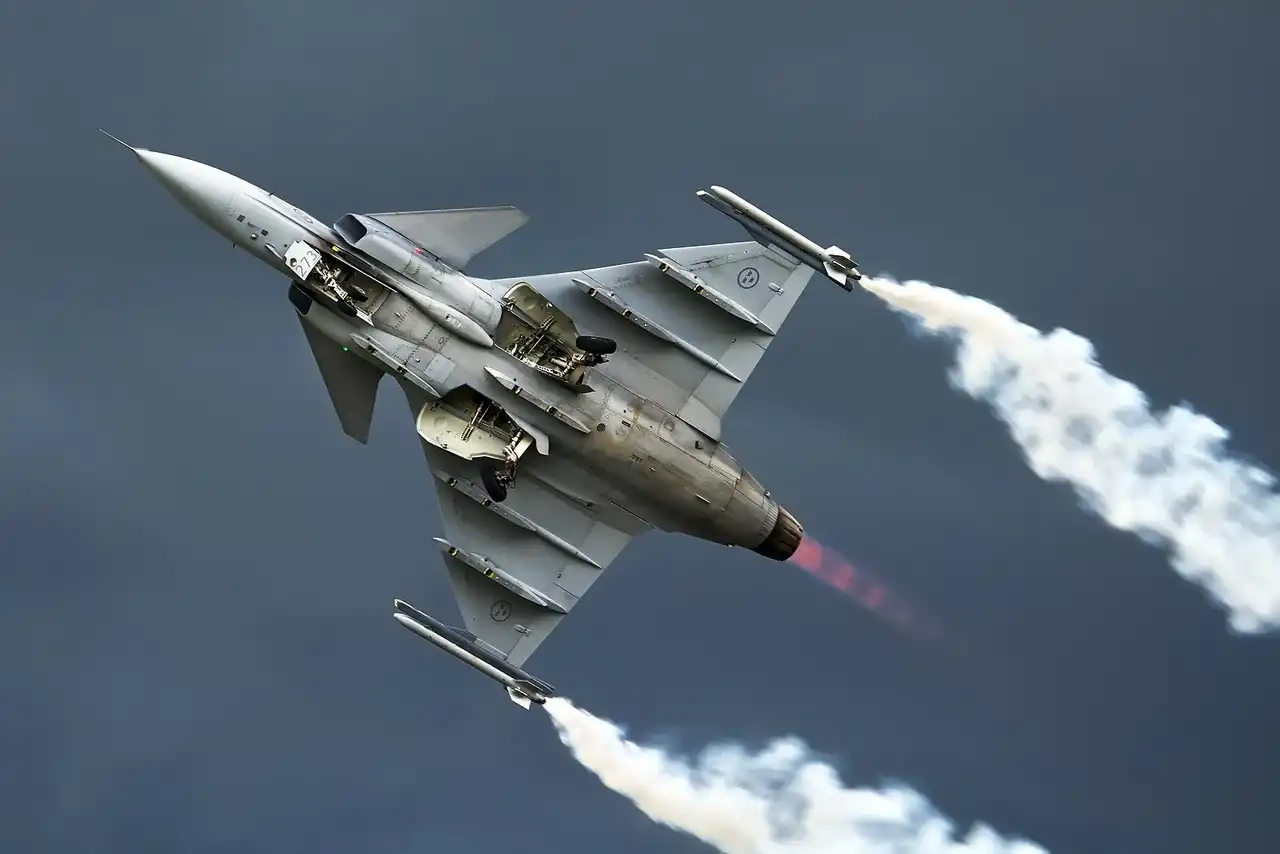
Gripen E Design and Technology
The Gripen relies on a classic cropped delta wing coupled with moving forward canards. This aerodynamic configuration generates exceptional lift and pitch agility, allowing the fighter to perform high-angle-of-attack maneuvers and operate from exceptionally short runways. In the E model, Saab redesigned the central fuselage, moving the main landing gear outward into wing fairings to increase internal fuel capacity by nearly 40% and accommodate heavier payload attachments.
F414 Engine
Powering the Gripen E is a single General Electric F414-GE-39E turbofan engine, an upgraded derivative of the powerplant used in the Boeing F/A-18E/F Super Hornet. The engine produces approximately 14,400 lbf (64 kN) of dry thrust and surges to 22,000 lbf (98 kN) with afterburner engaged. While specific data regarding engine lifespan and exact per-hour operating costs remain proprietary, the single-engine architecture is designed to keep maintenance requirements significantly lower than those of twin-engine competitors.
AESA Radar and IRST Sensor
At the heart of the Gripen E’s sensor suite is the Raven ES-05 AESA (Active Electronically Scanned Array) radar, developed by Leonardo. Unlike traditional fixed AESA radomes, the Raven ES-05 is mounted on a mechanical swashplate structure. This allows the radar antenna to physically rotate, expanding the aircraft’s field of view to roughly 100 degrees off-center—a critical tactical advantage that allows pilots to track targets while turning away to evade hostile missile locks.
Complementing the radar is the Skyward-G IRST (Infrared Search and Track) sensor situated just ahead of the cockpit canopy. This passive optical sensor detects heat signatures from enemy aircraft, drones, and missiles without emitting any electromagnetic signals, allowing the Gripen to track stealthy adversaries silently. Exact detection ranges for both sensors remain classified by military authorities.
Electronic Warfare and Avionics
Saab designed the Gripen E around a concept often called “digital survivability.” The aircraft features a 360-degree electronic warfare shield known as the MFS-EW (Multi-Functional System – Electronic Warfare). It seamlessly fuses radar warning receivers (RWR), missile approach warning systems (MAWS), chaff, flares, and active radar jammers. The platform also carries the EAJP (Electronic Attack Jammer Pod) for offensive electronic suppression and is being integrated with concepts like the LADM (Lightweight Air-launched Decoy Missile).
Inside the cockpit, the pilot manages the battlefield via a massive Wide Area Display (WAD)—a single tactical touchscreen developed in partnership with Brazilian aerospace firms. Coupled with a Helmet-Mounted Display (HMD), Hands-On Throttle and Stick (HOTAS) controls, and automated sensor fusion, the avionics reduce pilot workload by presenting a unified, real-time tactical picture of the airspace.
Armament and Offensive Capacity
The Gripen E is equipped with 10 external hardpoints for weapons, fuel tanks, and targeting pods. In an air-to-air superiority role, Saab states the fighter can carry up to seven long-range MBDA Meteor Beyond-Visual-Range (BVR) missiles alongside two short-range infrared-guided IRIS-T missiles.
For air-to-surface strike missions, the aircraft integrates laser- and GPS-guided munitions, including the GBU family and Small Diameter Bombs (SDB), as well as heavy anti-ship missiles and stand-off cruise missiles.
Performance and Technical Specifications
| Specification | Value |
| Maximum Speed | Mach 2 (approx. 1,528 mph / 2,460 km/h) |
| Cruise Speed | Mach 1.13 (approx. 870 mph / 1,400 km/h) |
| Service Ceiling | 52,500 ft (16,000 m) |
| Ferry Range | 2,485 miles (4,000 km) |
| Empty Weight | 17,637 lbs (8,000 kg) |
| Max Takeoff Weight | 36,376 lbs (16,500 kg) |
| Wingspan | 28.2 ft (8.6 m) |
A defining operational trait of the Gripen is its ability to operate from dispersed road bases. In wartime scenarios where airbases are destroyed, the Gripen can land on standard public highways. A mobile ground crew of just one technician and five conscripts can refuel the aircraft and fully rearm it for an air-to-air mission in under 15 minutes, using standard mobile equipment.
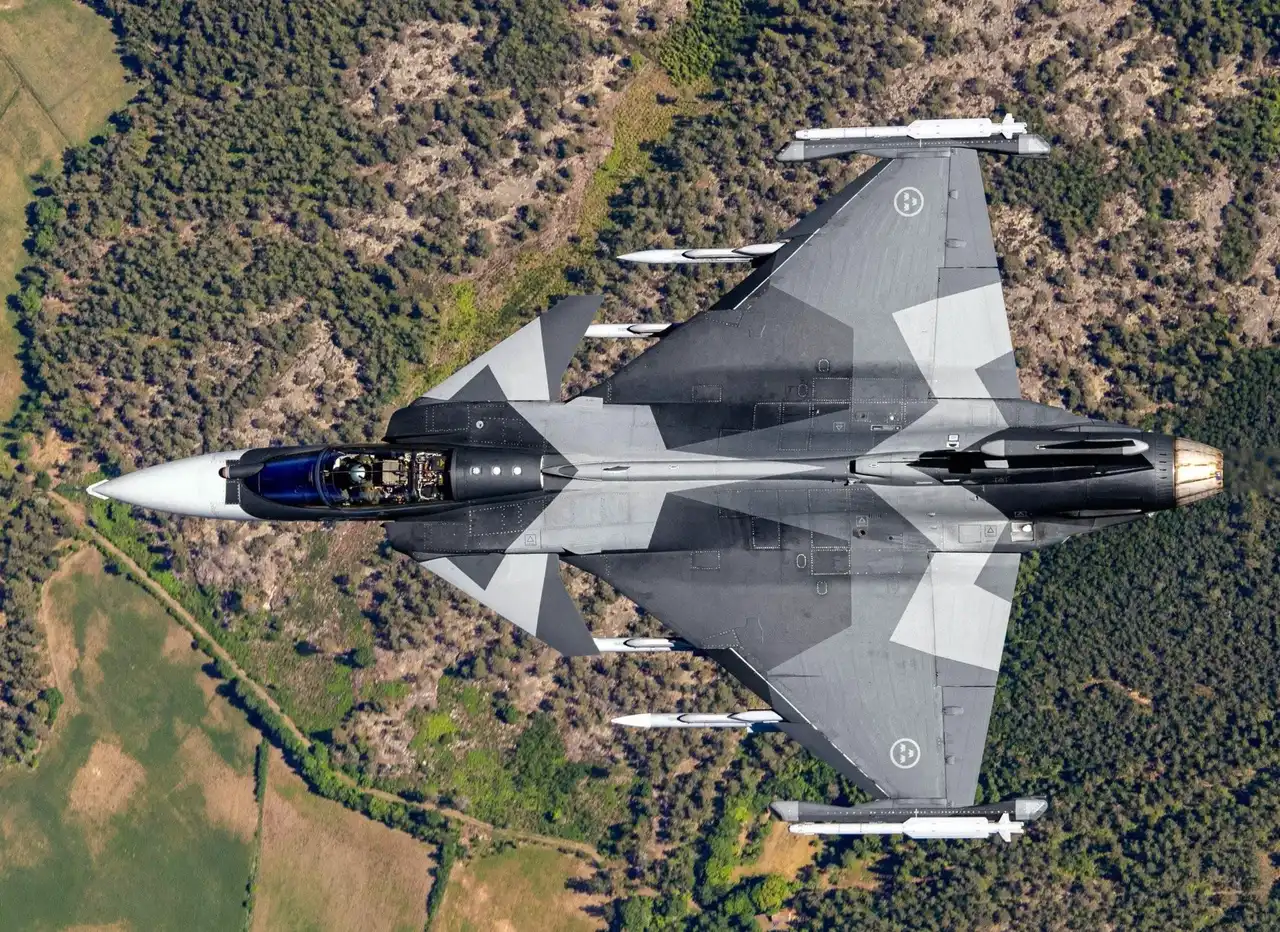
Combat History
While previous generations like the Gripen C/D have been deployed extensively in NATO-led international air policing missions and armed surveillance over Libya in 2011, there is no officially confirmed record of a Gripen engaging in combat air-to-air kills or dropping ordnance on hostile targets.
Similarly, the next-generation Gripen E/F has not yet seen actual combat deployment, as it remains in the early stages of operational integration with the Swedish and Brazilian air forces.
Gripen Variants
JAS 39A/B: The foundational first-generation single-seat (A) and two-seat (B) variants utilized exclusively by the Swedish Air Force.
JAS 39C/D: The NATO-compatible export generation, currently operating in Sweden, Hungary, the Czech Republic, Thailand, and South Africa.
JAS 39E: The modern single-seat next-generation variant featuring AESA radar, IRST, increased fuel capacity, and the F414 powerplant.
JAS 39F: The two-seat tandem version of the next-generation Gripen, heavily co-developed by Brazil for tactical training and complex electronic warfare missions.
Advantages and Disadvantages
Strategic Strengths
Advanced Sensor Fusion: Combining a swashplate AESA radar, passive IRST, and an integrated electronic warfare suite provides exceptional situational awareness.
Dispersed Operations: The ability to launch from 800-meter highway strips with minimal ground support makes it highly resilient against surprise missile attacks on major airbases.
Lifecycle Efficiency: Designed specifically to lower cost-per-flight-hour compared to twin-engine heavy fighters.
Lethal Loadout: Ten hardpoints with native integration of the Meteor missile give it top-tier BVR engagement reach.
Points of Attention
Unproven in Combat: Unlike rivals such as the F-16 or Rafale, the Gripen E/F lacks real-world combat verification.
Supply Chain Dependencies: The aircraft relies on an American-built General Electric engine and several foreign components, subject to third-party export controls.
Smaller Production Scale: With fewer global operators than the F-16 or F-35, the long-term economy of scale for spare parts and shared upgrades is more constrained.
Gripen E/F vs. F-16V: The Direct Competitor
When evaluating single-engine Western fighters available on the export market, Lockheed Martin’s F-16V (Block 70/72) stands as the Gripen E/F’s primary rival. Both aircraft aim to deliver advanced fourth-generation-plus capabilities without the immense procurement costs of fifth-generation stealth jets.
| Feature / Aspect | Gripen E/F vs. F-16V Comparison |
| Country of Origin | Gripen: Sweden F-16V: United States |
| Powerplant | Gripen: 1x GE F414-GE-39E F-16V: 1x Pratt & Whitney F100 or GE F110 |
| Radar Technology | Both utilize modern AESA radar architectures (Raven ES-05 vs. APG-83 SABR), though the Gripen features a rotating swashplate for a wider field of view. |
| Operational Focus | Gripen: Built for rapid highway turnarounds and dispersed warfare. F-16V: Leverages a massive global supply chain and decades of proven combat heritage. |
Note: Determining absolute superiority between the two depends heavily on a nation’s specific tactical requirements, existing infrastructure, and geopolitical alliances.
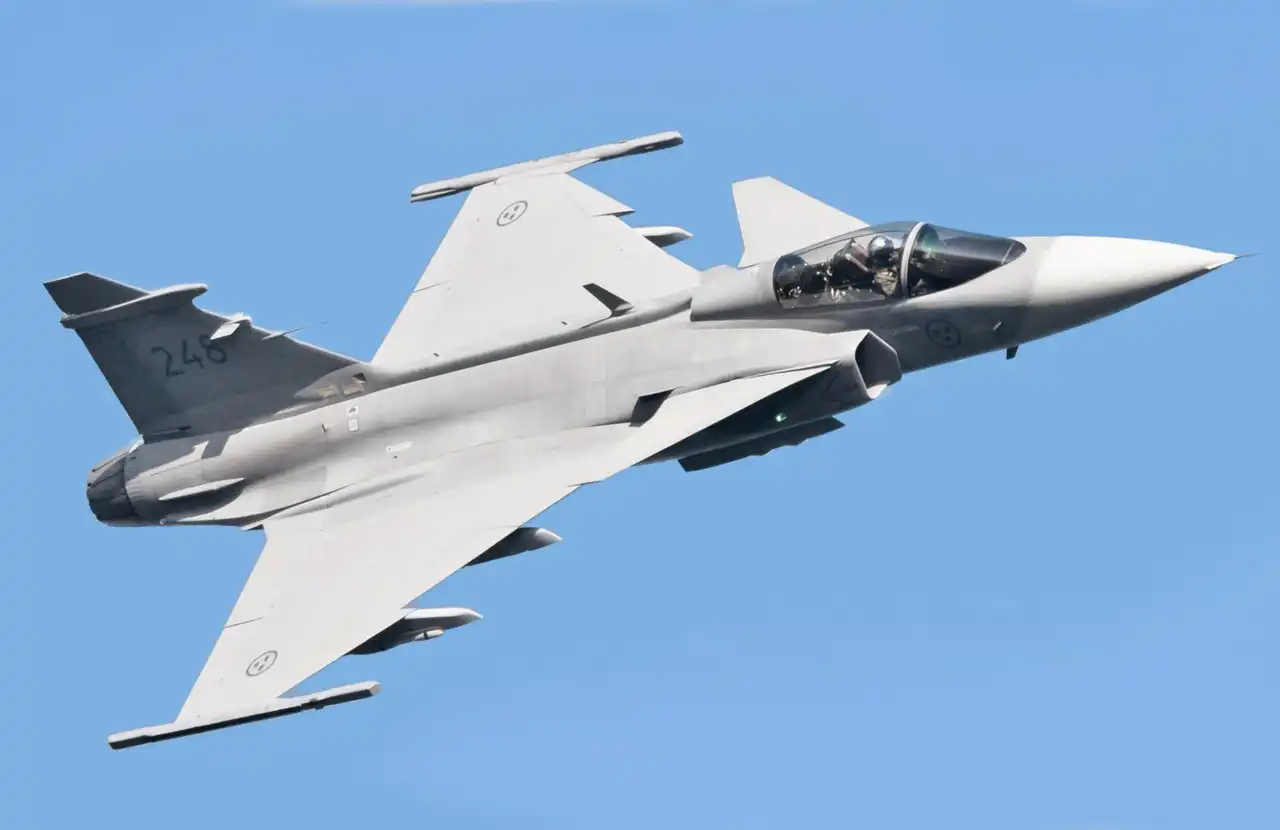
Interesting Facts About the Gripen
The JAS Acronym: It stands for Jakt, Attack, Spaning—the Swedish words for Hunting (Fighter), Attack, and Reconnaissance.
Swashplate Radar: Unlike most Western fighters with fixed radar noses, the Gripen’s AESA radar sits on a rotating base, widening its scanning angle by roughly 30% on either side.
Highway Runways: The aircraft is engineered to take off and land on standard road strips measuring just 16 meters (52 feet) wide and 800 meters (2,624 feet) long.
Brazilian Technology Transfer: The FX-2 agreement between Saab and Brazil included a massive technology transfer program that trained over 350 Brazilian engineers and established local manufacturing lines in São Paulo.
Military and Technological Impact
The Gripen E/F represents a deliberate shift in modern air warfare design: prioritizing software adaptability, electronic countermeasures, and networked sensor fusion over brute force and stealth shaping. By keeping operational costs manageable while delivering top-tier sensor capabilities, Saab has created a blueprint for air defense sustainability.
For Brazil, the F-39 Gripen is more than just a fighter purchase; it acts as a catalyst for domestic aerospace autonomy, elevating local defense industry standards through deep industrial collaboration.
Frequently Asked Questions
Has the Gripen E ever been used in combat?
No. While earlier C/D models participated in NATO air surveillance, there is no official confirmation that the Gripen E/F has ever engaged in active combat or weapon releases against hostile forces.
What is the difference between the Gripen E and Gripen F?
The Gripen E is a single-seat aircraft designed for tactical combat missions, whereas the Gripen F is a two-seat variant built for advanced pilot training and specialized multi-crew operations, such as complex electronic warfare.
What type of radar does the Gripen E use?
It uses the Raven ES-05, an Active Electronically Scanned Array (AESA) radar mounted on a mechanical rotating swashplate to provide a wider field of view than fixed-antenna radars.
How many weapons can the Gripen E carry?
The aircraft features 10 external hardpoints capable of carrying air-to-air missiles, precision bombs, anti-ship missiles, drop tanks, and targeting pods.
Why did Brazil choose the Gripen over other fighters?
Brazil selected the Gripen E/F in its FX-2 competition due to its favorable combination of operational performance, competitive lifecycle costs, and an extensive technology transfer agreement that allows Brazilian industry to co-develop and manufacture the aircraft locally.
Verdict
The Saab JAS 39 Gripen E/F is a formidable fourth-generation-plus multi-role fighter that successfully bridges the gap between high-end digital warfare and operational affordability. While it lacks the combat-proven résumé of some American and European rivals, its innovative swashplate AESA radar, robust electronic warfare shield, and unique capability to operate from rugged highway strips make it a highly resilient interceptor. For Sweden and Brazil, the Gripen represents both a credible deterrent against modern air threats and a masterclass in military industrial cooperation.

Joseli Lourenço
07/20/2026