
How the B-2 Spirit Works: Inside the World’s Most Sophisticated Bomber
The B-2 Spirit is the world’s only operational heavy stealth bomber — an aircraft capable of delivering nuclear and conventional weapons anywhere on Earth while remaining nearly invisible to modern radar systems.
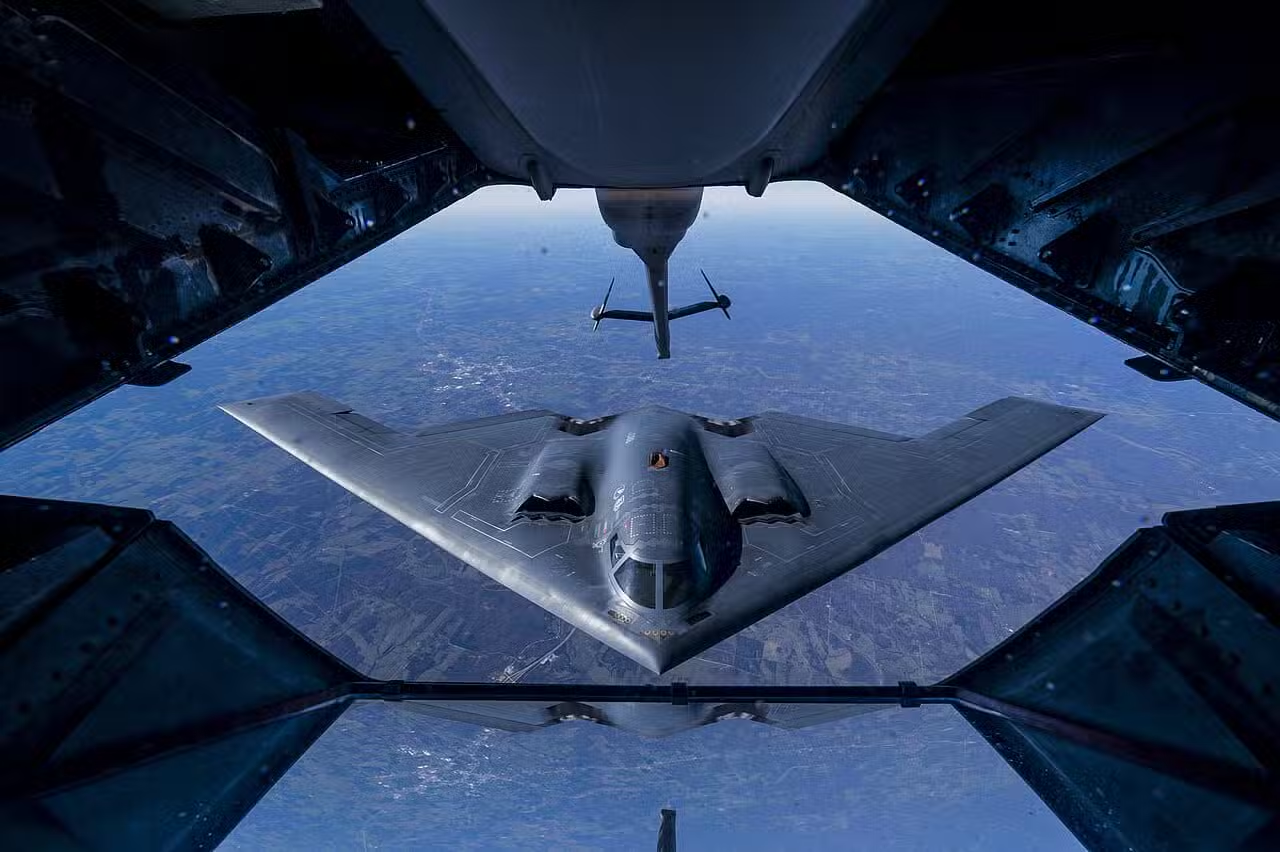
B-2 Spirit: The Invisible Bomber That Reshaped Modern Air Power
Few aircraft in history have commanded as much fear, fascination, and strategic respect as the B-2 Spirit. With its unmistakable flying wing silhouette, the ability to vanish from radar screens, and the capacity to carry weapons capable of leveling entire military installations, the B-2 stands apart — not just as a piece of military hardware, but as a statement of technological intent.
Conceived at the height of Cold War tensions and built in near-total secrecy, the B-2 Spirit was designed to do one thing above all else: reach any target on the planet, undetected, and destroy it. Decades after its first flight, that mission remains just as relevant — and the aircraft just as formidable.
Whether you’re an aviation enthusiast, a defense policy follower, or simply curious about the machines that shape global security, this is everything you need to know about the B-2 Spirit.
B-2 Spirit: Overview
The B-2 Spirit is a long-range, multi-role heavy stealth bomber operated exclusively by the United States Air Force. Its primary mission is strategic strike — delivering both nuclear and precision conventional weapons deep inside heavily defended enemy territory, without being detected by surface-to-air missile systems or fighter intercept radars.
What sets the B-2 apart from every other bomber in existence is its combination of extreme stealth capability and massive payload capacity — a combination that no other nation has successfully replicated to the same degree.
| Field | Data |
|---|---|
| Country of Origin | United States |
| Manufacturer | Northrop Grumman |
| Category | Heavy strategic stealth bomber |
| Primary Role | Deep penetration strategic strike |
| Crew | 2 pilots |
| Home Base | Whiteman AFB, Missouri |
| Operational Status | Active (retirement ~2032) |
The aircraft’s design philosophy — merging low observability with aerodynamic efficiency — was revolutionary when introduced and continues to influence military aviation programs worldwide.
History and Development
The Cold War Imperative
By the late 1970s, the U.S. Air Force faced an uncomfortable reality: Soviet air defense networks had grown sophisticated enough to pose a serious threat to conventional bombers. The existing B-52 fleet could no longer be relied upon to survive a deep penetration mission into Soviet airspace. A new kind of aircraft was needed — one that could fly undetected.
The program that would become the B-2 began under the classified designation Advanced Technology Bomber (ATB) in the late 1970s. In 1981, Northrop Corporation — later Northrop Grumman — was awarded the development contract, beating out a competing Lockheed/Rockwell team.
From Secrecy to the Skies
Development proceeded under extraordinary secrecy throughout the 1980s. The aircraft was publicly unveiled at Palmdale, California in November 1988, generating worldwide attention for its dramatic flying wing shape. The first flight took place on July 17, 1989, from Air Force Plant 42 in Palmdale.
Testing continued through the early 1990s, with the Air Force accepting initial deliveries in December 1993. Initial Operational Capability (IOC) was declared in April 1997 with the 509th Bomb Wing at Whiteman Air Force Base, Missouri — still the only base where B-2s are stationed.
Budget Cuts and a Smaller Fleet
Originally, the Air Force had planned to acquire 132 aircraft, with some projections reaching as high as 165. However, the collapse of the Soviet Union and congressional budget pressures reduced that figure dramatically. Only 21 aircraft were ever built, making each one extraordinarily valuable — and each potential loss a strategic crisis.
Design and Stealth Technology
The Flying Wing Philosophy
The B-2’s flying wing configuration is not accidental — it is the foundation of its stealth capability. By eliminating the vertical tail surfaces found on conventional aircraft, Northrop engineers removed one of the largest radar reflection points on any airframe. The blended fuselage-wing design creates a smooth, continuous surface that deflects radar energy rather than bouncing it back to the source.
Despite a wingspan of 172 feet (52.4 meters), the B-2 presents a radar cross-section (RCS) approximately equivalent to a small bird — an engineering achievement that remains classified in its specifics.
What Makes It “Invisible”
The B-2’s low observability comes from multiple overlapping systems:
Radar-absorbent materials (RAM): Specialized composite materials and coatings applied to the airframe absorb radar energy instead of reflecting it
Geometry: Every surface angle is calculated to minimize radar return
Exhaust suppression: Engine exhaust channels are designed to reduce infrared signature
Internal weapons bays: All ordnance is carried internally, eliminating external pylons that would increase radar visibility
Acoustic and visual minimization: Engine placement and exhaust routing reduce noise and visible signatures
Avionics and Electronic Systems
All B-2s have been upgraded to the Block 30 standard, which includes an Active Electronically Scanned Array (AESA) radar for both navigation and targeting.
Recent modernization efforts have added significant electronic capability:
MUOS (Mobile User Objective System) satellite communications — encrypted, jam-resistant, and operable in contested environments
SATURN UHF/VHF communications for NATO interoperability
Link 16 data link for in-flight mission retasking
Advanced IFF (Identification Friend or Foe) systems
GPS-denied targeting capability, allowing the aircraft to use its own radar to supply weapons coordinates when GPS jamming is present
This last upgrade is particularly significant in the current threat environment, where adversaries like Russia and China have invested heavily in GPS jamming technology.
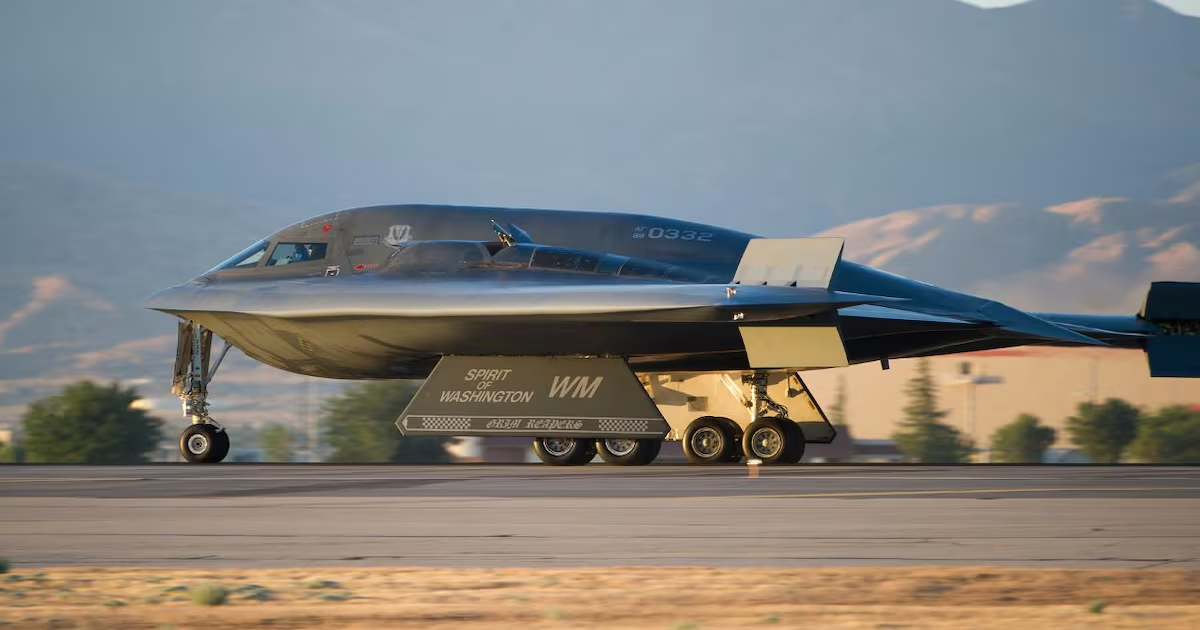
Armament
The B-2 carries all of its weapons in two internal rotary launchers and bomb racks, keeping the outer surface clean and radar-transparent. The total internal payload capacity reaches 60,000 pounds (27,216 kg) — among the highest of any aircraft in the U.S. inventory.
Nuclear Weapons
Up to 16 × B61-7, B61-12, or B83 gravity bombs on rotary launchers
B61-11 earth-penetrating nuclear bombs
Conventional Weapons
80 × Mk 82 500-lb unguided bombs
80 × GBU-38 JDAMs (GPS-guided, 500 lb)
16 × GBU-31 JDAMs (GPS-guided, 2,000 lb)
16 × AGM-158 JASSM cruise missiles
16 × AGM-158B JASSM-ER (extended-range cruise missiles — recently integrated)
8 × GBU-28 bunker-buster bombs
Mk 62 naval mines
The integration of the JASSM-ER — with a range exceeding 500 miles — allows the B-2 to strike heavily defended targets while remaining outside the engagement envelope of most modern surface-to-air missile systems.
Performance
The B-2 is subsonic by design — stealth, not speed, is its primary survival mechanism. That said, its performance figures are impressive for an aircraft of its size and weight.
| Performance Metric | Value |
|---|---|
| Maximum Speed | Mach 0.95 (~600 mph / 972 km/h) |
| Unrefueled Range | ~6,900 miles (11,100 km) |
| Range with Aerial Refueling | Effectively unlimited |
| Service Ceiling | 50,000 ft (15,240 m) |
| Maximum Payload | 60,000 lb (27,216 kg) |
| Fuel Capacity | ~167,000 lb (75,750 kg) |
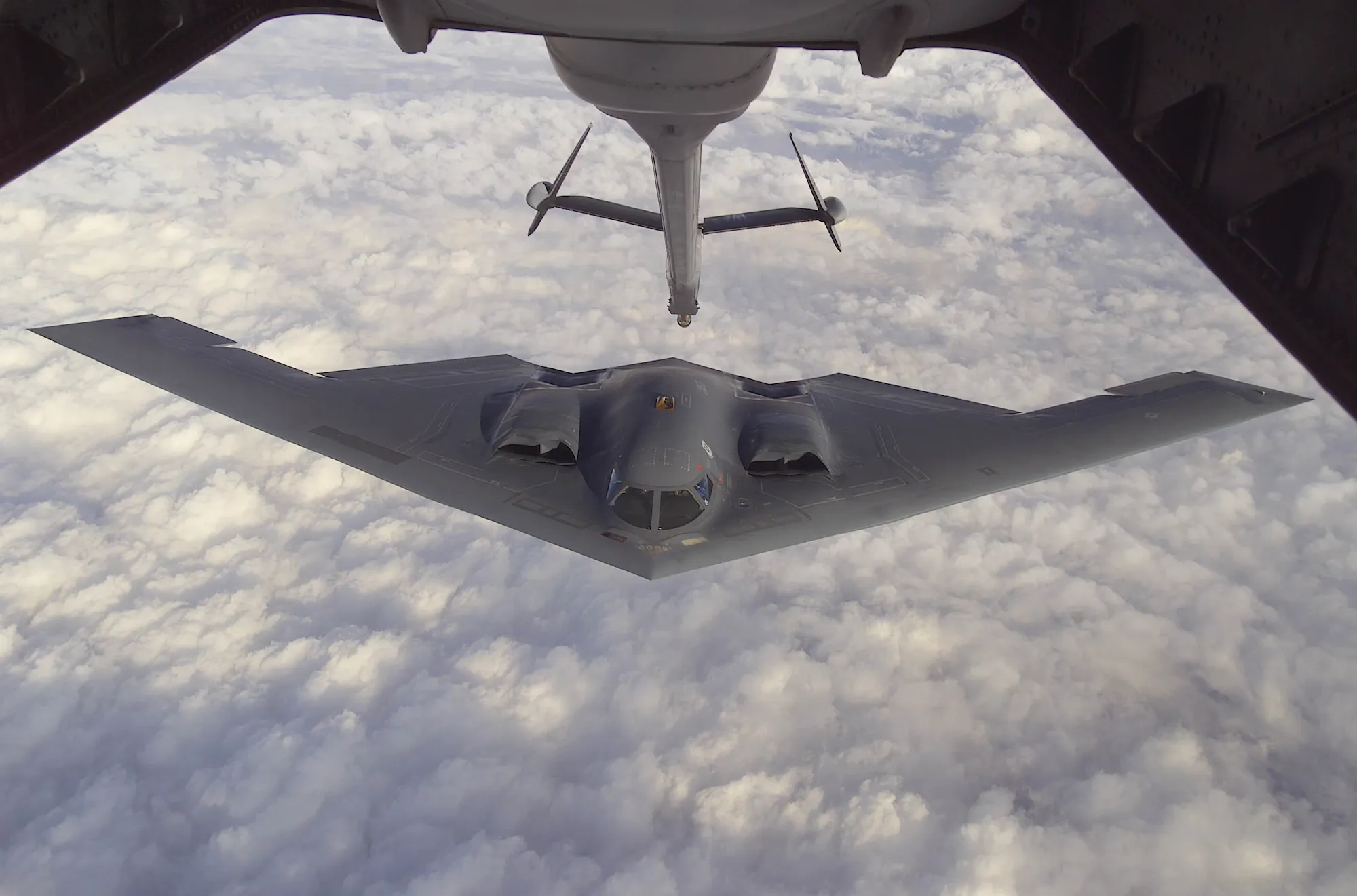
With aerial refueling, B-2 crews have completed missions lasting over 40 hours, flying from Whiteman AFB in Missouri, striking targets on the other side of the globe, and returning to base — all without landing. These missions require pre-positioned tanker support and crew rest protocols developed specifically for the aircraft.
Technical Specifications
| Specification | Details |
|---|---|
| Country | United States |
| Manufacturer | Northrop Grumman |
| First Flight | July 17, 1989 |
| IOC (Operational) | April 1997 |
| Crew | 2 pilots |
| Empty Weight | 158,000 lb (71,670 kg) |
| Max Takeoff Weight | 336,500 lb (152,635 kg) |
| Length | 69 ft (20.9 m) |
| Wingspan | 172 ft (52.4 m) |
| Height | 17 ft (5.1 m) |
| Maximum Speed | Mach 0.95 |
| Range (unrefueled) | ~6,900 miles (11,100 km) |
| Engine | 4 × General Electric F118-GE-100 |
| Thrust per Engine | 17,300 lbf |
| Primary Armament | B61 / B83 nuclear gravity bombs |
| Secondary Armament | JASSM-ER, JDAM, bunker busters |
| Total Built | 21 |
| Operational Status | Active (retirement ~2032) |
Combat History
Kosovo, 1999 — Combat Debut
The B-2 Spirit entered combat for the first time on March 24, 1999, during Operation Allied Force over the former Yugoslavia. B-2s flew non-stop from Whiteman AFB, Missouri — a round trip exceeding 30 hours — to strike Serbian military and infrastructure targets. This mission was a defining moment: it proved the B-2 could execute intercontinental precision strikes in real combat conditions.
Afghanistan, 2001
Within weeks of the September 11 attacks, B-2s were flying combat missions over Afghanistan as part of Operation Enduring Freedom, targeting Taliban command infrastructure and cave complexes in the opening days of the war.
Iraq, 2003
B-2 Spirits participated in the opening hours of Operation Iraqi Freedom, striking high-value targets across Iraq with precision-guided munitions. Their ability to deliver large payloads with pinpoint accuracy made them invaluable for time-sensitive targeting.
Libya, 2011
During Operation Odyssey Dawn, three B-2s flew from Whiteman AFB to Libya and back — one of the longest combat missions ever flown — destroying key Libyan Air Force infrastructure to support the international coalition.
Yemen, 2024–2026
B-2 Spirits have been deployed in strikes against Houthi military positions in Yemen, demonstrating that the aircraft remains a frontline combat asset more than two decades after its operational debut.
Advantages
Unmatched stealth: Radar cross-section equivalent to a small bird, despite a 172-foot wingspan
Global reach: Any target on Earth can be struck from Whiteman AFB with aerial refueling
Dual nuclear/conventional capability: The same airframe delivers both mission types
Massive payload: 60,000 lb internal weapons capacity — the highest of any U.S. stealth platform
Precision: AESA radar and GPS-denied targeting ensure accuracy even in jammed environments
Strategic deterrence: The threat of invisible attack fundamentally alters adversary decision-making
Proven combat record: Deployed in five distinct conflicts across three decades
Disadvantages
Cost: Unit cost averages $2.1 billion when R&D is factored in — by far the most expensive aircraft ever built
Fleet size: With only 20 operational aircraft, the loss of even one is a significant strategic event
Maintenance burden: Radar-absorbent coatings are fragile, temperature-sensitive, and require climate-controlled hangars
Subsonic only: The B-2 cannot outrun a modern supersonic interceptor — stealth is its only escape
Low-frequency radar vulnerability: Modern VHF-band radars (such as Russia’s Nebo-M system) can degrade stealth effectiveness under certain conditions
Weather sensitivity: Adverse weather and moisture can compromise RAM coatings, requiring post-flight maintenance
How the B-2 Compares to Its Rivals
| Feature | B-2 Spirit | B-21 Raider | Tu-160 Blackjack |
|---|
| Feature | B-2 Spirit | B-21 Raider | Tu-160 Blackjack |
|---|---|---|---|
| Country | USA | USA | Russia |
| Wingspan | 172 ft | ~132 ft | 182 ft (variable) |
| Payload | 60,000 lb | ~20,000 lb | ~88,000 lb |
| Stealth | Very High | Extremely High | Low |
| Top Speed | Mach 0.95 | ~Mach 0.95 (est.) | Mach 2.05 |
| Unit Cost | ~$2.1B | ~$692M | ~$250M |
| Nuclear Capable | Yes | Yes | Yes |
| Combat Record | Extensive | None yet | Limited |
| Fleet Size | 20 | In production | ~16 |
The B-21 Raider is the B-2’s designated successor — more stealthy, significantly cheaper, and built on open-architecture electronics, but with a smaller payload. Russia’s Tu-160 is dramatically faster, but lacks meaningful stealth and would be detectable by modern Western air defense networks.
Variants and Upgrades
The B-2 was manufactured in three progressive production blocks, all of which were subsequently upgraded to the most advanced standard:
Block 10: Initial production variant with limited conventional weapons capability
Block 20: Expanded conventional weapons integration and improved avionics
Block 30: Full nuclear and conventional capability; AESA radar; all aircraft now upgraded to this standard
Key modernization programs currently active or recently completed:
AESA radar installation across the fleet
JASSM-ER cruise missile integration
MUOS secure satellite communications
Upgraded cockpit displays with open-system architecture for future weapons integration
Improved RAM coatings and radar-absorbent structures including radome and engine inlet/exhaust treatments
Advanced IFF systems
Link 16 in-flight retasking capability
These upgrades are specifically designed to maintain the B-2’s ability to penetrate increasingly sophisticated integrated air defense systems (IADS) operated by near-peer adversaries.
10+ Fast Facts About the B-2 Spirit
Climate-controlled housing only: Every B-2 must be stored in a temperature and humidity-controlled facility — outdoor exposure degrades its radar-absorbent coatings within hours.
The most expensive aircraft ever built: At an average program cost of ~$2.1 billion per airframe, no other warplane in history comes close.
Only 21 were ever made: Congress originally planned to buy 132–165 aircraft; the end of the Cold War cut that to 21.
One has been lost: On February 23, 2008, the “Spirit of Kansas” crashed on takeoff from Andersen Air Force Base, Guam — the only B-2 ever lost in an accident. Both crew members ejected safely.
It can strike 16 separate targets in a single pass, with individually guided munitions directed at each one simultaneously.
Inspired by Jack Northrop’s 1940s flying wings: The B-2 is the spiritual successor to experimental aircraft built by Jack Northrop decades earlier — a vision he never saw realized during his lifetime.
The entire fleet is stationed at one base: All operational B-2s are based at Whiteman AFB, Missouri — a deliberate concentration of strategic capability.
Two aircraft were damaged in separate ground incidents (2021 and 2022), prompting a six-month fleet-wide stand-down that ended in May 2023.
Crews can sleep during missions: Ultra-long missions use crew rest rotations, with fold-out bunks and meal provisions built into the aircraft.
The B-2 was used in Libya’s opening strikes — three aircraft flew from Missouri to North Africa and back, one of the longest combat sorties ever recorded.
Its exact radar cross-section remains classified — the Air Force has never officially disclosed the precise RCS figure.
Strategic Impact on Military Aviation
The B-2 Spirit didn’t just introduce stealth to the heavy bomber category — it fundamentally redefined what a strategic bomber could accomplish. Before the B-2, the conventional wisdom held that large aircraft and low observability were mutually exclusive engineering goals. The B-2 proved that wrong.
Its legacy extends well beyond its own airframe. The flying wing stealth concept pioneered by the B-2 directly influenced the design of the B-21 Raider, the RQ-170 Sentinel unmanned reconnaissance platform, and various classified programs. Nations including China have studied B-2 design principles extensively in developing their own stealth bomber programs, including the Xian H-20.
From a doctrinal standpoint, the B-2 shifted how the U.S. military — and its adversaries — think about air power. No adversary with a B-2 threat on the table can assume any location is safe, any command bunker unreachable, or any radar network sufficient. That psychological dimension is as powerful as any bomb in its bay.
Frequently Asked Questions
How many B-2 Spirit bombers are currently operational?
The U.S. Air Force operates 20 B-2 Spirit bombers. All are assigned to the 509th Bomb Wing at Whiteman AFB, Missouri.
Is the B-2 Spirit truly invisible to radar?
Not completely. Its radar cross-section is extraordinarily small — comparable to a large bird — but modern low-frequency VHF radars can detect it under certain conditions. Stealth reduces detectability; it does not guarantee invisibility.
How much does a B-2 Spirit cost?
Production cost per aircraft was approximately $737 million. When research and development expenses are distributed across the 21-aircraft fleet, the average total cost rises to approximately $2.1 billion per plane.
Can the B-2 carry nuclear weapons?
Yes. The B-2 Spirit is one of the USAF’s primary nuclear delivery platforms. It can carry up to 16 B61-series or B83 nuclear gravity bombs on internal rotary launchers.
What is the B-2 Spirit’s range?
Approximately 6,900 miles (11,100 km) without aerial refueling. With in-flight refueling support, the aircraft has effectively unlimited global range.
When will the B-2 Spirit retire?
The current timeline calls for the B-2 fleet to be retired around 2032, once the B-21 Raider reaches sufficient operational numbers to replace it.
What wars has the B-2 Spirit fought in?
The B-2 has seen combat in Kosovo (1999), Afghanistan (2001), Iraq (2003), Libya (2011), and more recently in Yemen.
Why does the B-2 need a special hangar?
Its radar-absorbent coatings are sensitive to moisture, humidity, and temperature fluctuations. Without controlled storage, the stealth properties degrade, requiring costly and time-consuming restoration.
Can the B-2 Spirit refuel in flight?
Yes. It is equipped with a receptacle for aerial refueling, enabling missions of 40 hours or more when tanker support is available.
What replaces the B-2 Spirit?
The B-21 Raider, also built by Northrop Grumman, is the B-2’s designated replacement. It is smaller, less expensive (~$692 million per unit), and incorporates next-generation stealth and avionics technology.
The Ghost That Shaped a Century of Air Power
The B-2 Spirit is one of a small number of weapons systems that genuinely altered the course of military history — not through volume or speed, but through the simple and terrifying idea that a large, heavily armed aircraft could become nearly impossible to find.
In an era when air defense systems are more capable than ever, the B-2 continues to fly, strike, and return — a Cold War concept that has outlasted the conflict that created it and remained relevant across five wars on four continents. Its successor, the B-21 Raider, will carry its philosophy forward, but the Spirit’s contribution to aviation, strategy, and deterrence is permanent.
For readers who want to go deeper into the technology and strategy of modern airpower, exploring the B-21 Raider, the F-22 Raptor, or the history of the SR-71 Blackbird will reveal just how far — and how deliberately — the United States has pushed the limits of what military aviation can achieve.

Joseli Lourenço
06/18/2026